2016 · GS Paper 2 · Q13 · 12 marks
Has the Indian governmental system responded adequately to the demands of Liberalization, Privatization and Globalization started in 1991 ? What can the government do to be responsive to this important change ?
In short
The Indian governmental system has responded adequately to liberalisation in markets and regulation but only partially in administration, justice and inclusion. Independent regulators, GST and the Insolvency and Bankruptcy Code contrast with India's rank of 163 of 190 on enforcing contracts in Doing Business 2020.
Model answer
Ghissu Editorial · Verified 4 Oct 2026 · 276 words
Independent regulators
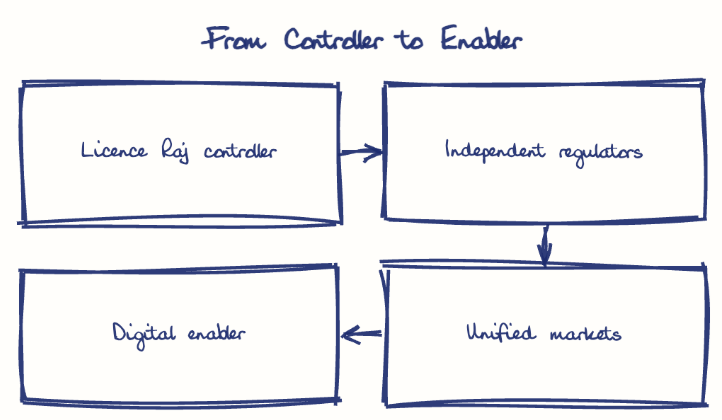
SEBI (1992), TRAI (1997) and the Competition Commission under the 2002 Act now referee liberalised markets.
Market-wide reforms
GST (2017) unified indirect taxes, and the Insolvency and Bankruptcy Code, 2016 gave creditors a time-bound exit.
Open investment
About 90% of FDI now comes through the automatic route, with almost all sectors open to 100% foreign ownership (RBI Governor, 2025).
Colonial-era bureaucracy
Generalist, seniority-bound services still run technical regulation, as the Second ARC (2008) noted.
Slow justice
India ranked 163 of 190 on enforcing contracts in Doing Business 2020.
Policy uncertainty
The 2012 retrospective tax on Vodafone was repealed only in 2021.
Rigid factor markets
Labour law stayed split across 29 central Acts until four codes replaced them, leaving most workers informal.
Skilled personnel
Lateral entry and Mission Karmayogi (2020) should bring domain expertise into regulation.
Trust-based regulation
The Jan Vishwas Act, 2023 decriminalised 183 provisions in 42 central Acts, and states should follow.
Cooperative federalism
The GST Council model can carry reform into state subjects such as land and power.
This model answer is indicative and the model can make mistakes; please verify key facts independently.
Practise this question
1Get the answer sheet
Sized for this question.
2Write your answer
Timed, by hand.
3Get it marked
Your score and what to fix.
This chapter in the exam
Poverty and Hunger4 questions
Asked in 4 of 14 sittings since 2013
- 2024Poverty and malnutrition create a vicious cycle, adversely affecting human capital formation. What steps can be taken to break the cycle ?
- 2019There is a growing divergence in the relationship between poverty and hunger in India. The shrinking of social expenditure by the government is forcing the poor to spend more on non-food essential items squeezing their food-budget. — Elucidate.
All 4 questions, sorted by sub-topic, with model answers and practice.
Question from the official UPSC Civil Services (Main) Examination 2016 paper. Answer written by Ghissu's engine and checked against our editorial standards. Found an error? Tell us and we correct it within 48 hours.