2019 · GS Paper 2 · Q7 · 10 marks
There is a growing divergence in the relationship between poverty and hunger in India. The shrinking of social expenditure by the government is forcing the poor to spend more on non-food essential items squeezing their food-budget. — Elucidate.
In short
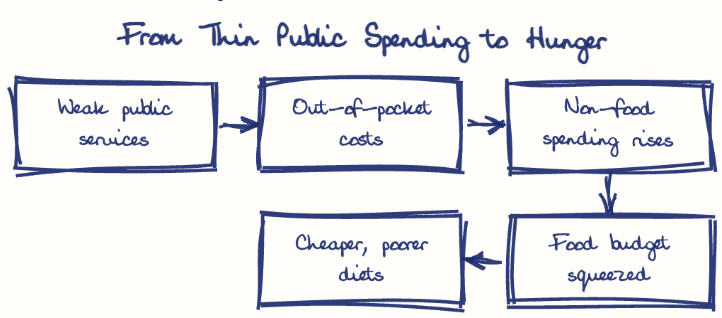
Poverty has fallen faster than hunger because households now pay for health, schooling and other non-food essentials that weak public services fail to provide, squeezing what they spend on nutritious food. Food fell from about 53% of rural spending in 2011-12 to about 46% in 2022-23.
Model answer
Ghissu Editorial · Verified 4 Oct 2026 · 277 words
Calorie puzzle
NSS rounds show per capita calorie intake declining from the 1980s even as real spending rose.
Shrinking food share
Food fell from about 53% of rural spending in 2011-12 to about 46% in the Household Consumption Expenditure Survey 2022-23.
Malnutrition outlasts poverty
NFHS-4 (2015-16) still found 38.4% of children stunted, far above what the fall in poverty would predict.
Health costs
Out-of-pocket spending was 64.2% of total health expenditure in 2013-14, and Selvaraj and others (2018) estimated it pushed about 5.5 crore Indians into poverty in a year.
Private schooling
Weak government schools push poor parents towards fees, coaching and transport, paid out of the kitchen budget.
Non-food essentials
Fuel, rent, mobile phones and travel are now unavoidable, and many Ujjwala households return to firewood because refills cost too much.
Stagnant rural wages
Slow wage growth leaves no surplus, so households cut the most flexible item, nutritious food.
This model answer is indicative and the model can make mistakes; please verify key facts independently.
Practise this question
1Get the answer sheet
Sized for this question.
2Write your answer
Timed, by hand.
3Get it marked
Your score and what to fix.
This chapter in the exam
Poverty and Hunger4 questions
Asked in 4 of 14 sittings since 2013
- 2024Poverty and malnutrition create a vicious cycle, adversely affecting human capital formation. What steps can be taken to break the cycle ?
- 2017Hunger and poverty are the biggest challenges for good governance in India still today. Evaluate how far successive governments have progressed in dealing with these humongous problems. Suggest measures for improvement.
All 4 questions, sorted by sub-topic, with model answers and practice.
Question from the official UPSC Civil Services (Main) Examination 2019 paper. Answer written by Ghissu's engine and checked against our editorial standards. Found an error? Tell us and we correct it within 48 hours.