2016 · GS Paper 2 · Q10 · 12 marks
"In the Indian governance system, the role of non-state actors has been only marginal." Critically examine this statement.
In short
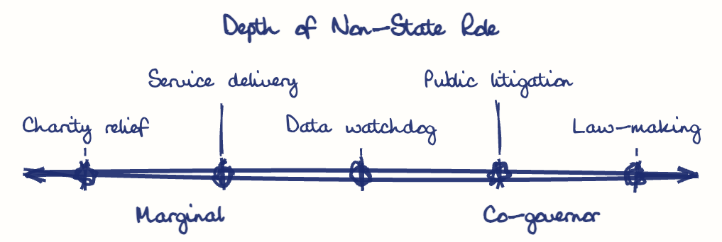
The claim that non-state actors are marginal in Indian governance does not hold, since they have shaped laws, delivered services and enforced accountability, though their institutional space is narrow and tightly regulated. MKSS's campaign produced the RTI Act 2005.
Model answer
Ghissu Editorial · Verified 4 Oct 2026 · 273 words
Writing the law
MKSS's jan sunwais produced the RTI Act 2005, and the PUCL v Union of India petition (2001) made mid-day meals an entitlement later codified in the NFSA 2013.
Delivering services
Akshaya Patra feeds over two million schoolchildren daily with governments, and Kerala runs its poverty mission through Kudumbashree.
Holding power to account
Pratham's ASER surveys exposed the learning crisis, and ADR's petitions won candidate asset disclosure (2002) and the end of electoral bonds (2024).
State-centric policy space
The National Advisory Council was wound up in 2014, and pre-legislative consultation is often bypassed.
Regulatory squeeze
The 2020 FCRA amendment banned sub-granting and capped administrative spending at 20%.
Accountability deficit
The CBI told the Supreme Court in 2015 that only about a tenth of NGOs filed accounts.
Uneven and dependent reach
NGOs and CSR money cluster in a few states, and many survive as grant-funded contractors of the State.
This model answer is indicative and the model can make mistakes; please verify key facts independently.
Practise this question
1Get the answer sheet
Sized for this question.
2Write your answer
Timed, by hand.
3Get it marked
Your score and what to fix.
This chapter in the exam
NGOs5 questions
Asked in 4 of 14 sittings since 2013
- 2023Discuss the contribution of civil society groups for women's effective and meaningful participation and representation in state legislatures in India.
- 2021Can Civil Society and Non-Governmental Organizations present an alternative model of public service delivery to benefit the common citizen? Discuss the challenges of this alternative model.
All 5 questions, sorted by sub-topic, with model answers and practice.
Question from the official UPSC Civil Services (Main) Examination 2016 paper. Answer written by Ghissu's engine and checked against our editorial standards. Found an error? Tell us and we correct it within 48 hours.