2016 · GS Paper 2 · Q17 · 12 marks
"The broader aims and objectives of WTO are to manage and promote international trade in the era of globalization. But the Doha round of negotiations seem doomed due to differences between the developed and the developing countries." Discuss in the Indian perspective.
In short
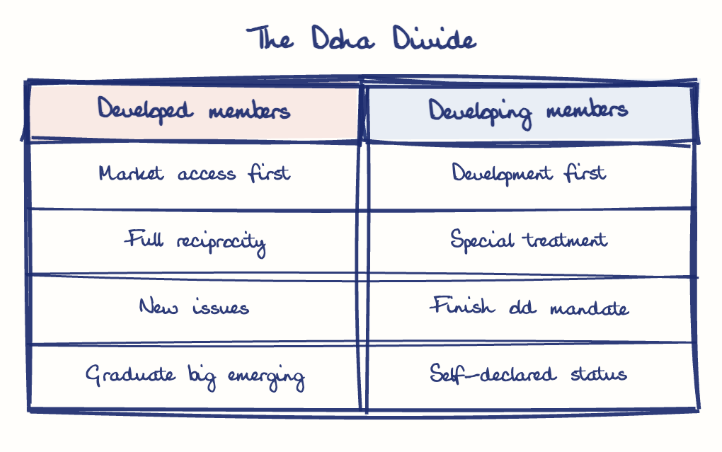
The Doha Round stalled because developed members resisted farm-subsidy cuts and safeguards while demanding market access from developing members. For India, whose MSP procurement the Bali peace clause protects, a consensus-based WTO is preferable to mega-regionals like the TPP, where it has no seat.
Model answer
Ghissu Editorial · Verified 4 Oct 2026 · 294 words
Farm subsidies
The US, EU and Japan resisted deep subsidy cuts while seeking access to developing markets, and developed members still hold about 95% of AMS entitlements (RIS, 2025).
Safeguards and market access
Talks broke down in 2008 over India and the US disagreeing on the Special Safeguard Mechanism trigger, while developed members demanded deep industrial tariff cuts yet resisted the professional mobility (Mode 4) India sought.
Defensive interests
With over half its workforce in agriculture (Census 2011), India needs space for MSP procurement, which the Bali peace clause (2013) protected.
Gains banked
Nairobi's end to farm export subsidies and the Bali Trade Facilitation Agreement show progress by instalments, not a dead system.
Cost of collapse
A dead Doha shifts rule-making to mega-regionals like the TPP and TTIP, where India has no seat yet faces their labour, environment and patent standards.
Offensive interests unmet
India's edge in IT and professional services needed Mode 4 openings, which it later pursued through bilateral deals.
This model answer is indicative and the model can make mistakes; please verify key facts independently.
Practise this question
1Get the answer sheet
Sized for this question.
2Write your answer
Timed, by hand.
3Get it marked
Your score and what to fix.
This chapter in the exam
Institutions12 questions
Asked in 10 of 14 sittings since 2013
- 2025"The reform process in the United Nations remains unresolved, because of the delicate imbalance of East and West and entanglement of the USA vs. Russo-Chinese alliance." Examine and critically evaluate the East-West policy confrontations in this regard.
- 2024Terrorism has become a significant threat to global peace and security.' Evaluate the effectiveness of the United Nations Security Council's Counter Terrorism Committee (CTC) and its associated bodies in addressing and mitigating this threat at the international level.
All 12 questions, sorted by sub-topic, with model answers and practice.
Question from the official UPSC Civil Services (Main) Examination 2016 paper. Answer written by Ghissu's engine and checked against our editorial standards. Found an error? Tell us and we correct it within 48 hours.