2016 · GS Paper 2 · Q20 · 12 marks
What are the aims and objectives of the McBride Commission of the UNESCO ? What is India's position on these ?
In short
UNESCO's MacBride Commission (1977) aimed to correct the one-way North to South flow of news and democratise communication through a New World Information and Communication Order. India championed it through the Non-Aligned Movement, hosting the 1976 New Delhi information ministers' conference, while insisting on a free press.
Model answer
Ghissu Editorial · Verified 4 Oct 2026 · 282 words
Balance and democratise
It sought a "free and balanced flow" in place of one-way North to South news, a right to communicate and limits on media concentration and commercialisation.
Capacity and safeguards
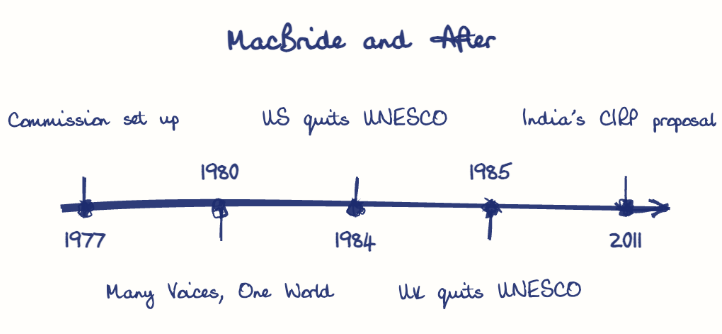
It urged Southern news agencies and training, which UNESCO's International Programme for the Development of Communication (1980) funds, and protection for journalists and culture, while rejecting censorship.
Champion through NAM
India hosted the 1976 New Delhi meeting of Non-Aligned information ministers that backed the Non-Aligned News Agencies Pool, and B.G. Verghese sat on the Commission.
Balance with a free press
Fresh from the Emergency (1975-77), India backed balanced flow but not state control of news, and stayed engaged when the US (1984) and UK (1985) quit UNESCO calling NWICO a cover for censorship.
Digital continuity
India proposed a UN Committee for Internet-Related Policies in 2011 and championed digital public infrastructure in its 2023 G20 presidency.
This model answer is indicative and the model can make mistakes; please verify key facts independently.
Practise this question
1Get the answer sheet
Sized for this question.
2Write your answer
Timed, by hand.
3Get it marked
Your score and what to fix.
This chapter in the exam
Institutions12 questions
Asked in 10 of 14 sittings since 2013
- 2025"The reform process in the United Nations remains unresolved, because of the delicate imbalance of East and West and entanglement of the USA vs. Russo-Chinese alliance." Examine and critically evaluate the East-West policy confrontations in this regard.
- 2024Terrorism has become a significant threat to global peace and security.' Evaluate the effectiveness of the United Nations Security Council's Counter Terrorism Committee (CTC) and its associated bodies in addressing and mitigating this threat at the international level.
All 12 questions, sorted by sub-topic, with model answers and practice.
Question from the official UPSC Civil Services (Main) Examination 2016 paper. Answer written by Ghissu's engine and checked against our editorial standards. Found an error? Tell us and we correct it within 48 hours.