2016 · GS Paper 3 · Q11 · 12 marks
Give an account of the current status and the targets to be achieved pertaining to renewable energy sources in the country. Discuss in brief the importance of National Programme on Light Emitting Diodes (LEDs).
In short
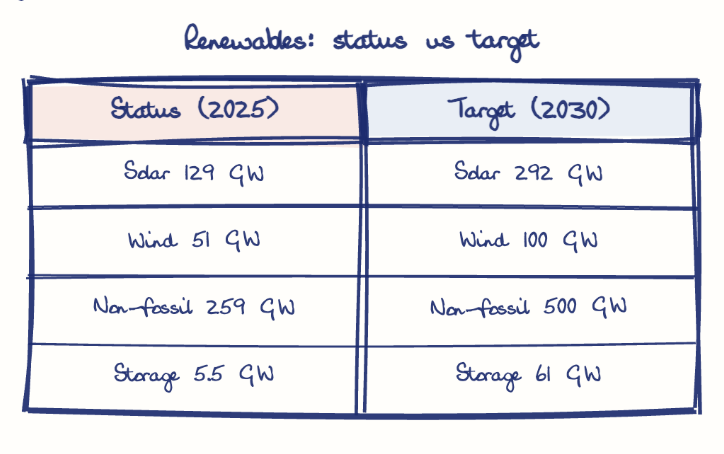
India's non-fossil capacity reached over 259 GW of a 505 GW total by October 2025, against a target of 500 GW by 2030. The National LED Programme's UJALA scheme distributed 36.87 crore LED bulbs and cut LED prices from Rs 450-500 to about Rs 70.
Model answer
Ghissu Editorial · Verified 4 Oct 2026 · 294 words
Met and missed
The 175 GW goal was missed, but the 40% non-fossil pledge was met in 2021, nine years early (PIB, 2021).
Solar surge
Solar rose from about 3 GW in 2014 to 129 GW in 2025 (PIB), helped by solar parks, PM-KUSUM and PM Surya Ghar.
Targets ahead
The COP26 Panchamrit seeks 500 GW non-fossil capacity by 2030, the National Green Hydrogen Mission 5 MMT of green hydrogen, and India net zero by 2070.
Gaps
Storage of only about 5.5 GW against 243 GW of renewables and no polysilicon manufacturing remain bottlenecks (Standing Committee on Energy, 2025).
Efficiency
Launched in 2015 and run by EESL, UJALA distributed 36.87 crore LED bulbs by 2025; LEDs use about 90% less power than incandescent bulbs (PIB).
Market shift
Bulk procurement cut LED prices from Rs 450-500 to about Rs 70 without subsidy.
Discoms and streets
Lower peak demand eases discom stress, and the street lighting programme replaced over 1.3 crore streetlights.
This model answer is indicative and the model can make mistakes; please verify key facts independently.
Practise this question
1Get the answer sheet
Sized for this question.
2Write your answer
Timed, by hand.
3Get it marked
Your score and what to fix.
This chapter in the exam
Developments, Applications and Effects in Everyday Life23 questions
Asked in 13 of 14 sittings since 2013
- 2026Distinguish between a Fast Breeder Reactor (FBR) and a thermal nuclear reactor. In the context of first indigenously developed prototype FBR at Kalpakkam, explain the term 'criticality'. What are its implications for clean energy future of our country? (Answer in 150 words)
- 2025How can India achieve energy independence through clean technology by 2047 ? How can biotechnology play a crucial role in this endeavour ?
All 23 questions, sorted by sub-topic, with model answers and practice.
Question from the official UPSC Civil Services (Main) Examination 2016 paper. Answer written by Ghissu's engine and checked against our editorial standards. Found an error? Tell us and we correct it within 48 hours.