2016 · GS Paper 3 · Q5 · 12 marks
Justify the need for FDI for the development of the Indian economy. Why there is gap between MOUs signed and actual FDIs? Suggest remedial steps to be taken for increasing actual FDIs in India.
In short
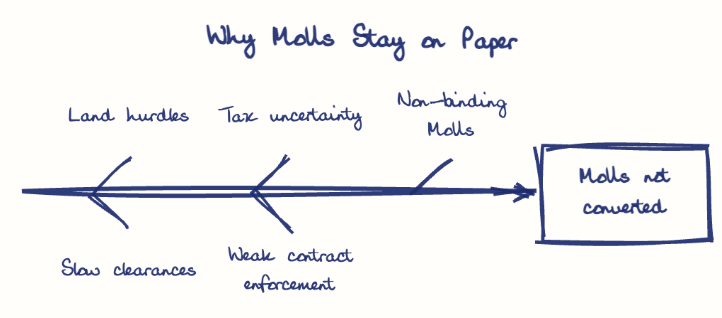
India needs FDI for non-debt capital, technology and jobs, but MoUs often fail to convert because of land hurdles, slow clearances and policy uncertainty. POSCO's ₹52,000 crore Odisha steel MoU of 2005, abandoned in 2017, shows how the gap arises.
Model answer
Ghissu Editorial · Verified 4 Oct 2026 · 275 words
Non-debt capital
FDI fills the savings-investment gap and finances the current account deficit more stably than portfolio flows.
Technology and jobs
Foreign firms bring technology and supplier networks, as Suzuki did for cars and Foxconn for iPhones, creating jobs for a workforce that needs about 78.5 lakh non-farm jobs a year (Economic Survey 2023-24).
Land and clearances
POSCO's 2005 MoU for a ₹52,000 crore steel plant in Odisha was abandoned in 2017 after land and forest-clearance disputes.
Policy uncertainty
The 2012 retrospective tax after the Vodafone verdict and India's 163rd rank in enforcing contracts (Doing Business 2020) raised risk.
Signalling MoUs
Non-binding MoUs showcase summits without financial closure.
Time-bound approvals
Extend the National Single Window System to state clearances and track every MoU publicly.
Stable rules
Build on the 2021 repeal of retrospective tax and the Jan Vishwas Act 2023 with faster commercial courts.
Ready land and incentives
Industrial parks, the India Industrial Land Bank and PLI cut entry costs.
This model answer is indicative and the model can make mistakes; please verify key facts independently.
Practise this question
1Get the answer sheet
Sized for this question.
2Write your answer
Timed, by hand.
3Get it marked
Your score and what to fix.
This chapter in the exam
Liberalization9 questions
Asked in 6 of 14 sittings since 2013
- 2025What are the challenges before the Indian economy when the world is moving away from free trade and multilateralism to protectionism and bilateralism ? How can these challenges be met ?
- 2018How would the recent phenomena of protectionism and currency manipulations in world trade affect macroeconomic stability of India?
All 9 questions, sorted by sub-topic, with model answers and practice.
Question from the official UPSC Civil Services (Main) Examination 2016 paper. Answer written by Ghissu's engine and checked against our editorial standards. Found an error? Tell us and we correct it within 48 hours.