2016 · GS Paper 3 · Q3 · 12 marks
Pradhan Mantri Jan-Dhan Yojana (PMJDY) is necessary for bringing unbanked to the institutional finance fold. Do you agree with this for financial inclusion of the poorer section of the Indian society? Give arguments to justify your opinion.
In short
PMJDY was necessary to bring the poor into institutional finance, since zero-balance accounts, DBT and linked insurance reached households that markets ignored, though thin usage and credit gaps remain. Some 58.63 crore Jan Dhan accounts had been opened by 1 July 2026, 56% held by women.
Model answer
Ghissu Editorial · Verified 4 Oct 2026 · 271 words
Only 35% of Indian adults had a bank account in 2011 (Global Findex). PMJDY, launched in 2014, had opened 58.63 crore accounts by 1 July 2026, raising the question of whether such a mission was necessary for the poor.
Why PMJDY Was Needed for the Unbanked Poor
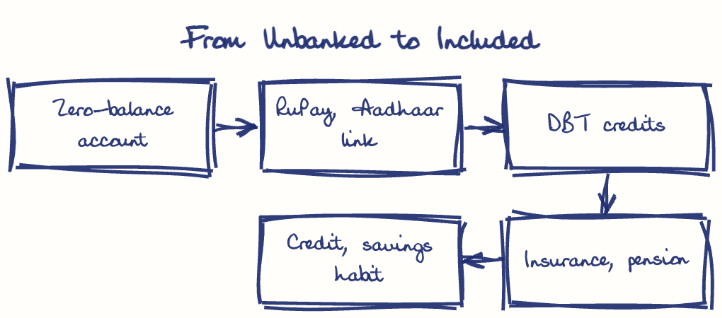
From Unbanked to Included → Zero-balance account → RuPay, Aadhaar link → DBT credits → Insurance, pension → Credit, savings habit
Access at scale
Zero-balance accounts reached those branch banking ignored; 56% of holders are women and about 78% of accounts are rural or semi-urban.
Pipe for welfare
JAM made DBT possible, with over Rs 51 lakh crore credited directly by June 2026.
Cover against shocks
RuPay accident cover, overdrafts and links to PMJJBY, PMSBY and Atal Pension Yojana protect poor families.
Unmatched speed
A World Bank G20 note (2023) found India reached 80% inclusion in six years instead of about 47.
Thin usage
Many accounts mainly receive DBT and hold small balances.
Credit gap
The poor still borrow informally, as overdrafts are small and Mudra fills only part of the need.
Literacy and fraud
Low digital literacy exposes new users to cyber fraud, and Business Correspondents are thinly paid.
Quality lags access
RBI's FI-Index rose to 67.0 in March 2025, but its quality sub-index grew only 5% over 2017-21.
This model answer is indicative and the model can make mistakes; please verify key facts independently.
Practise this question
1Get the answer sheet
Sized for this question.
2Write your answer
Timed, by hand.
3Get it marked
Your score and what to fix.
This chapter in the exam
Inclusive Growth11 questions
Asked in 9 of 14 sittings since 2013
- 2026Examine the view that financial inclusion is an integral part of social and economic inclusion in a country like India. Also throw light on the usefulness of the R.B.I.'s Financial Inclusion Index. (Answer in 150 words)
- 2023Distinguish between 'care economy' and 'monetized economy'. How can care economy be brought into monetized economy through women empowerment?
All 11 questions, sorted by sub-topic, with model answers and practice.
Question from the official UPSC Civil Services (Main) Examination 2016 paper. Answer written by Ghissu's engine and checked against our editorial standards. Found an error? Tell us and we correct it within 48 hours.