2016 · GS Paper 4 · Q11 · 20 marks
Suppose you are an officer in-charge of implementing a social service scheme to provide support to old and destitute women. An old and illiterate woman comes to you to avail the benefits of the scheme. However, she has no documents to show that she fulfils the eligibility criteria. But after meeting her and listening to her you feel that she certainly needs support. Your enquiries also show that she is really destitute and living in a pitiable condition. You are in a dilemma as to what to do. Putting her under the scheme without necessary documents would clearly be violation of rules. But denying her the support would be cruel and inhuman. (a) Can you think of a rational way to resolve this dilemma ? (b) Give your reasons for it.
In short
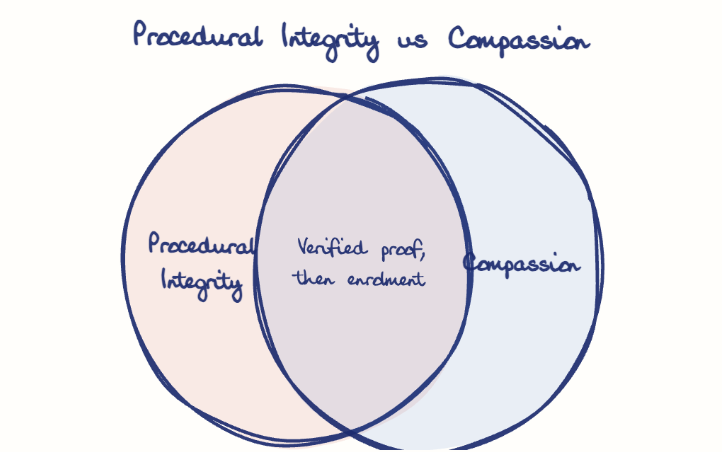
The officer should neither reject the woman nor enrol her without proof, but build lawful proof through a field verification report, self-declaration and a medical age certificate, giving interim relief meanwhile. This honours the rule's purpose and her Article 21 dignity, recognised in Francis Coralie Mullin (1981).
Model answer
Ghissu Editorial · Verified 4 Oct 2026 · 263 words
(i) CONFRONT [Strict-Legal]
Reject for want of papers, which is Moral Myopia.
(ii) CAPITULATE [Empathetic-Humanitarian]
Enrol without proof, a Dual-Standard Practice.
(iii) EVADE [Procedural-Evasive]
Ask her to return with papers, which is Moral Escapism.
(v) RECONCILE ✓ [Balanced]
Build lawful proof by official verification, give interim relief, then enrol (recommended).
Enquiry into evidence
A field report by the village officer and panchayat plus her self-declaration, as Lakshmir Bhandar's [scheme] one-page form allows.
Missing papers
Age certified by a government doctor and Aadhaar through UIDAI's introducer facility for people without documents.
Interim relief
Rations, shelter and the Red Cross fund while the file moves.
Purpose over form
The rule demands proof of eligibility, not a particular paper, so official verification honours it.
Dignity
Francis Coralie Mullin (1981) [case] read the right to live with human dignity into Article 21.
System, not favour
A recorded process serves every similar applicant, and the rule is amended to accept verified self-declarations.
This model answer is indicative and the model can make mistakes; please verify key facts independently.
Practise this question
1Get the answer sheet
Sized for this question.
2Write your answer
Timed, by hand.
3Get it marked
Your score and what to fix.
This chapter in the exam
Social Sector Dilemmas7 questions
Asked in 5 of 14 sittings since 2013
- 2026Lata, a mother of two children, was admitted to a hospital for acute abdominal pain. Her sister-in-law, Sujatha, accompanied her. Dr. Mansi examined Lata and recommended a diagnostic laparoscopy. Lata's consent was taken to conduct the medical procedure under general anesthesia. During the laparoscopy, Dr. Mansi's team discovered a tumor in Lata's uterus. A closer examination suggested that the tumor could be malignant. One option before Dr. Mansi was to extract a sample for biopsy. In that case, if the tumor was malignant, Lata would have to undergo another surgery for removal of the uterus. An alternative was to remove the uterus immediately. Dr. Mansi had to take a quick decision. As Lata was under general anesthesia, Dr. Mansi explained the situation to Sujatha. Sujatha agreed with Dr. Mansi's recommendations for a hysterectomy, wherein Lata's uterus would be removed to avoid the risk and pain of undergoing another surgery. Dr. Mansi removed Lata's uterus after receiving Sujatha's consent in writing. Lata was informed of this the next day. She was very upset and felt betrayed as she had not consented to the removal of her uterus. Lata complained to the police who tried to convince her that Dr. Mansi had acted with good intention to help a patient. Sujatha was of the same opinion, however Lata was not convinced and decided to approach the court. (a) Discuss the ethical issues involved in this case. (b) Discuss the moral conduct of the doctor in this situation.
- 2026Vikas is a government officer with over a decade of service in public administration. He has recently moved as the District Collector (DC) of Nainipura, a remote hilly district bordering a forest. Due to Nainipura's low levels of economic development, one of his major duties is to ensure proper functioning of the public distribution system (PDS) amongst the economically weaker sections (EWS). During his on-site visits, Vikas was apprised of a typical administrative challenge in operating the PDS. To prevent leakages, all distributors were required to carry out real-time biometric identification of the beneficiaries, whose fingerprints were tallied with identity card records. This was creating problems as the operating system sometimes rejected fingerprint matching in the cases of growing children, manual labourers and senior citizens. The problem was further compounded in periods of low WiFi connectivity. The distributors, in such cases, resorted to personal discretion when they could identify the recipient. Vikas had to address this problem on priority. Strictly adhering to government regulations would ensure fiscal probity but would greatly trouble the proposed beneficiary, i.e., EWS. It may even impinge on their fundamental right to life as per Article 21 of the Constitution. Conversely, leaving the resolution solely to the discretion of the distributors could lead to misuse and leakages. (a) What are the options open to Vikas? How should he balance fiscal probity with empathy towards the designated beneficiaries? (b) Discuss the ethics of using technology as a gatekeeper for welfare schemes.
All 7 questions, sorted by sub-topic, with model answers and practice.
Question from the official UPSC Civil Services (Main) Examination 2016 paper. Answer written by Ghissu's engine and checked against our editorial standards. Found an error? Tell us and we correct it within 48 hours.