2017 · GS Paper 1 · Q2 · 10 marks
Clarify how mid-eighteenth century India was beset with the spectre of a fragmented polity.
In short
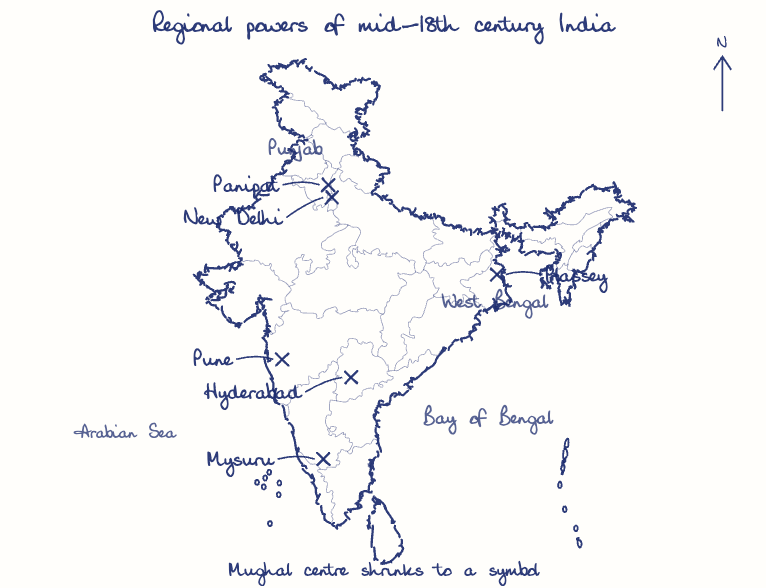
Mid-eighteenth century India was a fragmented polity because the Mughal centre survived only as a symbol while successor states, rebel kingdoms, invaders and European companies competed for its legacy. Hyderabad, Awadh and Bengal became hereditary kingdoms, and Nadir Shah's sack of Delhi in 1739 exposed the hollow centre.
Model answer
Ghissu Editorial · Verified 4 Oct 2026 · 260 words
Successor states
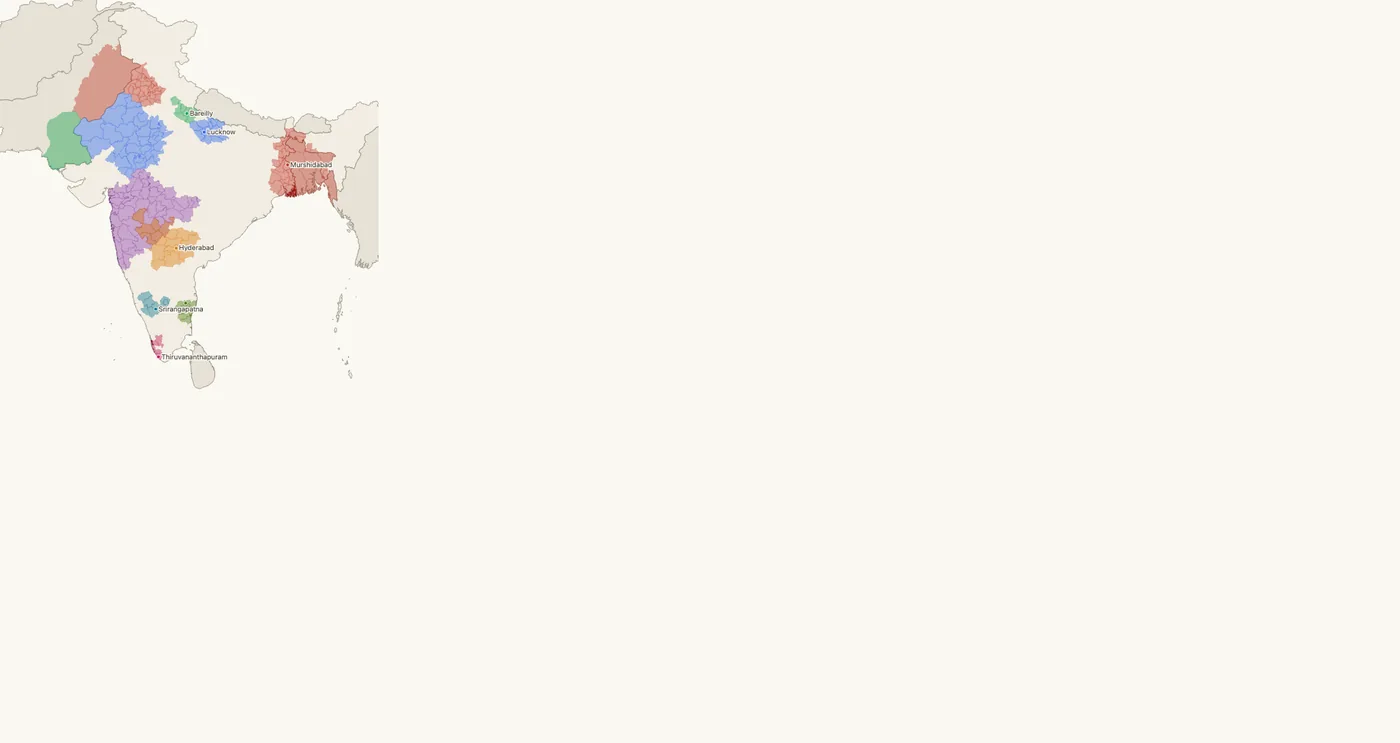
Governors made provinces hereditary, with Nizam-ul-Mulk in Hyderabad after 1724, Saadat Khan in Awadh and Alivardi Khan in Bengal, all nominally loyal to Delhi.
Rebel states
The Marathas, the Sikh misls, the Jats under Suraj Mal and the Rohillas rose by fighting the Mughals.
Independent kingdoms
Mysore under Haidar Ali and Travancore under Martanda Varma owed nothing to Delhi.
A divided confederacy
The Marathas themselves split among the Peshwa, Sindhia, Holkar, Gaekwad and Bhonsle.
Invasions
Nadir Shah's sack of Delhi (1739) and Ahmad Shah Abdali's raids culminating at Panipat (1761) drained the centre.
Jagirdari crisis
Satish Chandra traces the collapse to a shortage of jagirs for a swelling nobility, which spread revenue farming and court factions.
European rivalry
The Carnatic Wars (1746-63) and Plassey (1757) let the English and French exploit succession disputes.
Revisionist caveat
Muzaffar Alam and C.A. Bayly show that Awadh and Bengal prospered, so the break-up was political, not economic.
This model answer is indicative and the model can make mistakes; please verify key facts independently.
Practise this question
1Get the answer sheet
Sized for this question.
2Write your answer
Timed, by hand.
3Get it marked
Your score and what to fix.
This chapter in the exam
The Coming of Europeans3 questions
Asked in 3 of 14 sittings since 2013
- 2022Why did the armies of the British East India Company – mostly comprising of Indian soldiers – win consistently against the more numerous and better equipped armies of the then Indian rulers? Give reasons.
- 2014The third battle of Panipat was fought in 1761. Why were so many empire-shaking battles fought at Panipat?
Question from the official UPSC Civil Services (Main) Examination 2017 paper. Answer written by Ghissu's engine and checked against our editorial standards. Found an error? Tell us and we correct it within 48 hours.