2022 · GS Paper 1 · Q2 · 10 marks
Why did the armies of the British East India Company – mostly comprising of Indian soldiers – win consistently against the more numerous and better equipped armies of the then Indian rulers? Give reasons.
In short
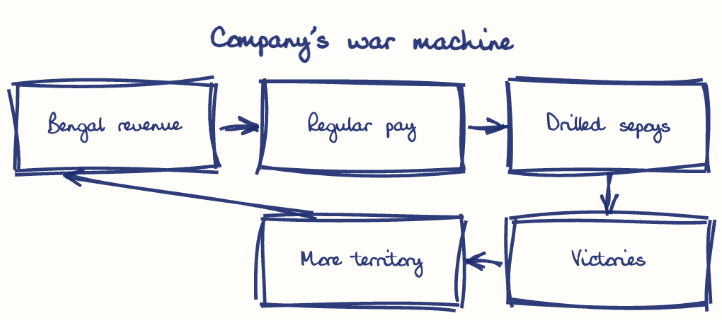
The Company's mostly Indian armies won because European drill, regular pay, a unified officer command and combined arms made sepoys cohesive, while Bengal's revenue and Indian disunity sustained its wars. At Plassey in 1757, about 3,000 Company troops defeated a Bengal army of some 50,000.
Model answer
Ghissu Editorial · Verified 4 Oct 2026 · 271 words
Drill and discipline
European drill and volley fire made sepoys cohesive, as at Adyar (1746), where about 930 French troops and sepoys routed some 10,000 of the Carnatic Nawab's men.
Regular pay, steady loyalty
Sepoys were paid on time, while Indian armies fell into arrears and lived by plunder, breeding desertion.
Unified command
A professional officer cadre held one chain of command, whereas Indian armies were levies of jagirdars and sardars loyal to their own chiefs.
Combined arms
Rulers relied on massed cavalry despite good guns like Tipu's rockets, but the Company integrated infantry and field artillery, as at Assaye (1803).
Fiscal-military state
After the Diwani of 1765, Bengal's revenue paid for the army, the military fiscalism that C.A. Bayly describes.
Credit and collaborators
The Jagat Seths financed the Plassey conspiracy, and Mir Jafar's defection decided the battle.
Divide and ally
The Nizam and the Marathas joined Cornwallis against Tipu in 1790-92, and in 1803 Holkar stayed aloof while Sindhia and Bhonsle were beaten.
This model answer is indicative and the model can make mistakes; please verify key facts independently.
Practise this question
1Get the answer sheet
Sized for this question.
2Write your answer
Timed, by hand.
3Get it marked
Your score and what to fix.
This chapter in the exam
The Coming of Europeans3 questions
Asked in 3 of 14 sittings since 2013
Question from the official UPSC Civil Services (Main) Examination 2022 paper. Answer written by Ghissu's engine and checked against our editorial standards. Found an error? Tell us and we correct it within 48 hours.