2017 · GS Paper 1 · Q13 · 15 marks
Highlight the importance of the new objectives that got added to the vision of Indian independence since twenties of the last century.
In short
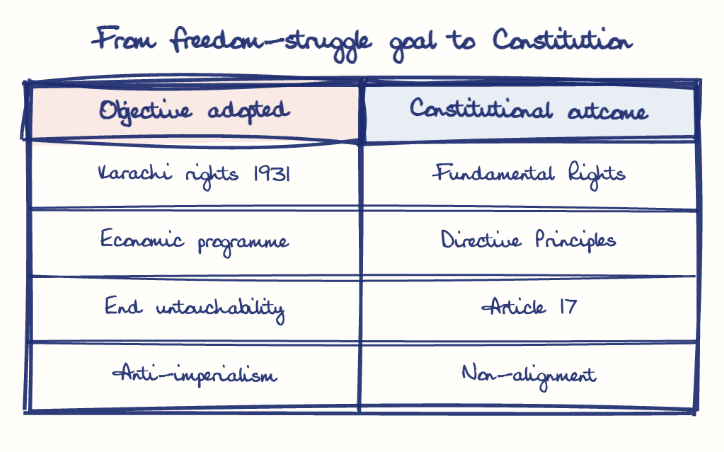
From the 1920s the vision of independence expanded from self-rule to Purna Swaraj, civil liberties, economic justice, social equality and anti-imperialism, giving the masses a stake in freedom. The Karachi Resolution of 1931 on fundamental rights and economic policy became the blueprint for the Constitution's Fundamental Rights and Directive Principles.
Model answer
Ghissu Editorial · Verified 4 Oct 2026 · 301 words
Complete independence and rights
The Lahore Congress (1929) adopted Purna Swaraj, and the Karachi Resolution (1931) listed free speech, equality and universal adult franchise.
Economic justice
Karachi promised a living wage and state control of key industries, Faizpur (1936) adopted an agrarian programme, and the National Planning Committee (1938) made planning a goal.
Social equality
The fight against untouchability, equal rights for women and a religiously neutral state widened freedom to dignity for all.
Federal and global vision
Linguistic provincial committees (Nagpur, 1920), Purna Swaraj for princely states (Haripura, 1938) and solidarity with colonised peoples (Brussels, 1927) broadened the goal.
Mass appeal
Land, wages and dignity gave peasants, workers, women and Dalits a stake in freedom.
Answer to critics
A social programme undercut the colonial claim that the Congress spoke only for the elite, and drew socialists and youth in.
Blueprint for the nation
These goals passed almost directly into the Constituent Assembly's work.
Unfinished agenda
Persisting caste discrimination keeps Ambedkar's call for social democracy relevant, and the Karachi pairing of liberty with livelihood still guides policy.
This model answer is indicative and the model can make mistakes; please verify key facts independently.
Practise this question
1Get the answer sheet
Sized for this question.
2Write your answer
Timed, by hand.
3Get it marked
Your score and what to fix.
This chapter in the exam
National Movement (1919–1928)2 questions
Asked in 2 of 14 sittings since 2013
Question from the official UPSC Civil Services (Main) Examination 2017 paper. Answer written by Ghissu's engine and checked against our editorial standards. Found an error? Tell us and we correct it within 48 hours.