2020 · GS Paper 1 · Q13 · 15 marks
Since the decade of the 1920s, the national movement acquired various ideological strands and thereby its social base. Discuss.
In short
From the 1920s, Gandhian, socialist, revolutionary and social-justice strands each drew peasants, workers, women, youth, Dalits and tribals into the national movement, though communal strands split away part of its base. The Congress won 617 of 864 general seats in the 1937 provincial elections.
Model answer
Ghissu Editorial · Verified 4 Oct 2026 · 284 words
Gandhian satyagraha
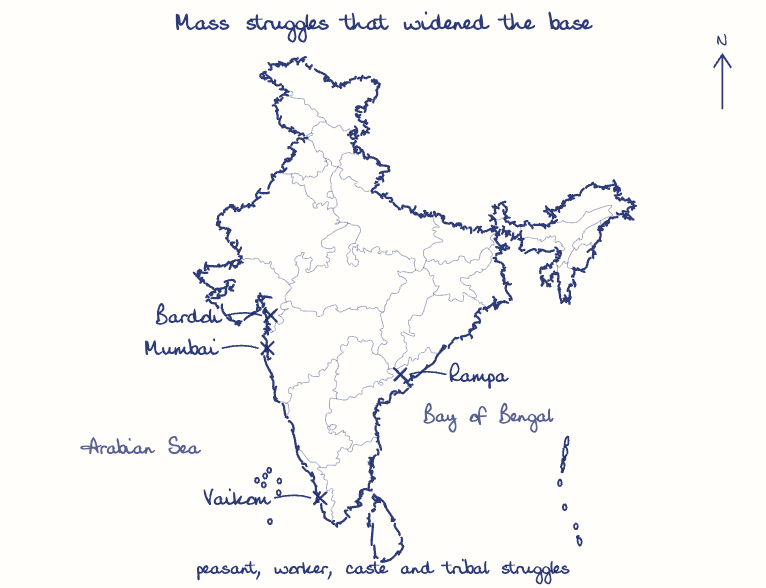
Mass non-violence, khadi and the Khilafat alliance (1920-22) brought peasants, women and Muslims in, and Bardoli (1928) proved peasant satyagraha.
Socialist left
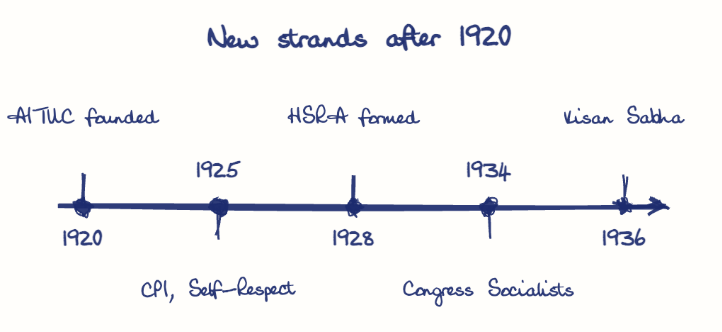
Nehru and Bose argued for economic equality, Communists led the 1928 Bombay textile strike, and the Kisan Sabha gave peasants their own organisation.
Revolutionary socialism
Bhagat Singh's HSRA and his execution in 1931 stirred students and youth.
Social justice
Periyar's Self-Respect Movement, Vaikom (1924-25) and Ambedkar's Mahad Satyagraha (1927) mobilised non-Brahmins and depressed classes.
Reach
The Congress won 617 of 864 general seats in 1937, and the States People's Conference (1927) reached princely states.
Fractures
The Bardoli resolution (1922) shielded landlords, the Muslim League built a rival base after 1937, and Ambedkar's separate electorate demand ended only in the Poona Pact (1932).
Plural umbrella
The Congress held Gandhians, socialists and liberals together.
Freedom with justice
The Karachi Resolution (1931) fused rights with economic justice, later carried into the Constitution.
This model answer is indicative and the model can make mistakes; please verify key facts independently.
Practise this question
1Get the answer sheet
Sized for this question.
2Write your answer
Timed, by hand.
3Get it marked
Your score and what to fix.
This chapter in the exam
National Movement (1919–1928)2 questions
Asked in 2 of 14 sittings since 2013
Question from the official UPSC Civil Services (Main) Examination 2020 paper. Answer written by Ghissu's engine and checked against our editorial standards. Found an error? Tell us and we correct it within 48 hours.