2017 · GS Paper 1 · Q5 · 10 marks
How does the Juno mission of NASA help to understand the origin and evolution of the earth?
In short
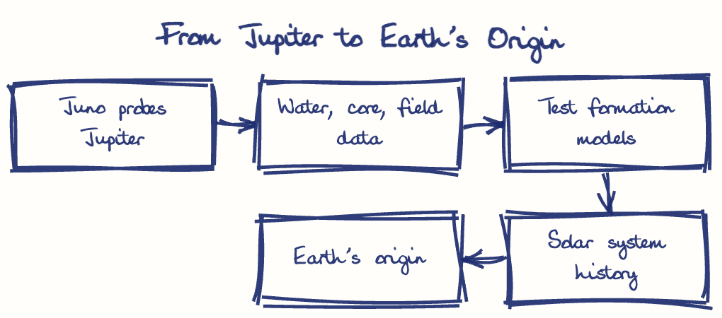
Juno helps explain the Earth's origin by studying Jupiter, the oldest planet, whose water, core and magnetic field preserve the solar nebula's original conditions and test planet-formation models. Its gravity data revealed a dilute, fuzzy core, testing how scientists think all planets, Earth included, grew.
Model answer
Ghissu Editorial · Verified 4 Oct 2026 · 276 words
Water and volatiles
Its microwave radiometer estimated in 2020 that water makes up about 0.25 percent of equatorial molecules, showing where icy material condensed in the young nebula.
A dilute core
Gravity data revealed a large, fuzzy core rather than a compact rocky one, testing the core-accretion model by which all planets are thought to have grown.
Magnetic dynamo
The magnetometer mapped an irregular field with a Great Blue Spot, offering a second laboratory for the dynamo that generates Earth's own field.
Building blocks
Jupiter's composition constrains the chemistry of the nebula from which Earth's rocks and gases condensed.
Delivery of water
Models such as the Grand Tack, in which a migrating Jupiter scattered water-rich asteroids inward, help explain Earth's oceans, and Juno's data constrain them.
A habitable planet
Flybys of Ganymede, Europa and Io show tidal heating and volcanism, clarifying how magnetic shielding and early volcanism shaped Earth's atmosphere.
This model answer is indicative and the model can make mistakes; please verify key facts independently.
Practise this question
1Get the answer sheet
Sized for this question.
2Write your answer
Timed, by hand.
3Get it marked
Your score and what to fix.
This chapter in the exam
The Earth7 questions
Asked in 6 of 14 sittings since 2013
- 2025Discuss how the changes in shape and sizes of continents and ocean basins of the planet take place due to tectonic movements of the crustal masses.
- 2022Discuss the natural resource potentials of Deccan Trap.
All 7 questions, sorted by sub-topic, with model answers and practice.
Question from the official UPSC Civil Services (Main) Examination 2017 paper. Answer written by Ghissu's engine and checked against our editorial standards. Found an error? Tell us and we correct it within 48 hours.