2022 · GS Paper 1 · Q6 · 10 marks
Discuss the natural resource potentials of Deccan Trap.
In short
The Deccan Trap's basalt offers fertile black cotton soil, bauxite, agate, building stone, hydropower, geothermal springs and geoheritage, though its hard-rock aquifers are shallow. Its regur soil makes Maharashtra and Gujarat India's leading cotton states.
Model answer
Ghissu Editorial · Verified 4 Oct 2026 · 276 words
Black cotton soil
Weathered basalt forms moisture-retentive regur rich in lime, iron and potash, making Maharashtra and Gujarat the leading cotton states and supporting soybean and sugarcane.
Bauxite and gemstones
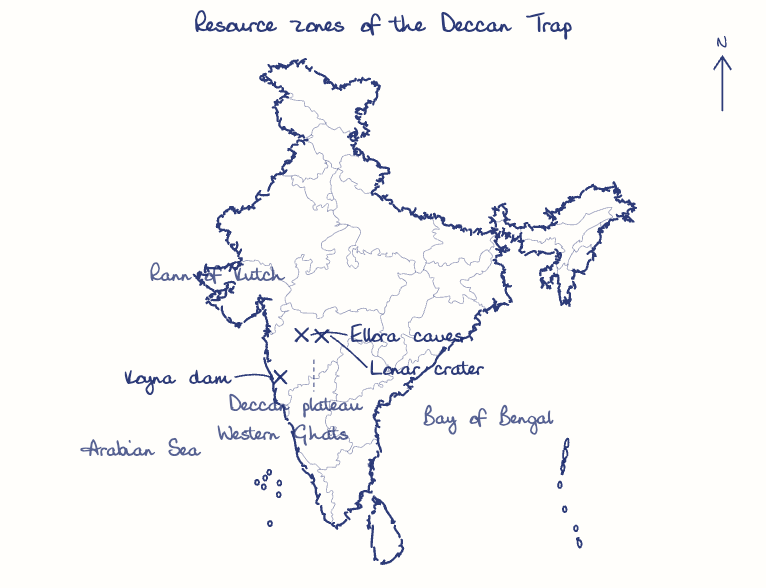
Laterite caps yield bauxite in Kolhapur and the Jamnagar-Kutch belt, while lava cavities hold agate and zeolites that sustain the agate craft of Khambhat.
Stone and aggregates
Durable basalt supplies building stone, road metal and crushed sand, and was carved into the caves of Ajanta and Ellora.
Rivers and hydropower
The Godavari, Krishna and Bhima rise on the trap-built Western Ghats, whose escarpment powers the Koyna project.
Groundwater with limits
Fractured basalt stores water, but these hard-rock aquifers are shallow and patchy, so Marathwada depends on watershed recharge.
Energy and geoheritage
Hot springs at Vajreshwari mark geothermal potential, sub-trappean sediments in Kutch are explored for hydrocarbons, and the Kaas Plateau and the Lonar crater, a Ramsar site since 2020, support ecotourism.
This model answer is indicative and the model can make mistakes; please verify key facts independently.
Practise this question
1Get the answer sheet
Sized for this question.
2Write your answer
Timed, by hand.
3Get it marked
Your score and what to fix.
This chapter in the exam
The Earth7 questions
Asked in 6 of 14 sittings since 2013
- 2025Discuss how the changes in shape and sizes of continents and ocean basins of the planet take place due to tectonic movements of the crustal masses.
- 2018Define mantle plume and explain its role in plate tectonics.
All 7 questions, sorted by sub-topic, with model answers and practice.
Question from the official UPSC Civil Services (Main) Examination 2022 paper. Answer written by Ghissu's engine and checked against our editorial standards. Found an error? Tell us and we correct it within 48 hours.