2017 · GS Paper 2 · Q9 · 10 marks
"China is using its economic relations and positive trade surplus as tools to develop potential military power status in Asia." In the light of this statement, discuss its impact on India as her neighbour.
In short
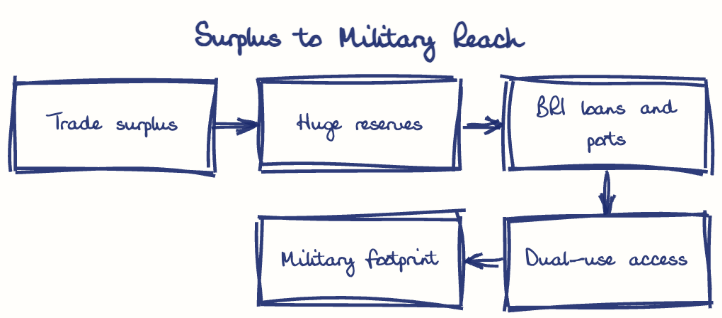
China converts its trade surplus and economic ties into military reach through Belt and Road ports, arms to Pakistan and supply-chain leverage, pressuring India on land, sea and trade. India's trade deficit with China of about US$99 billion in 2024-25 shows the depth of that dependence.
Model answer
Ghissu Editorial · Verified 4 Oct 2026 · 272 words
Funding modernisation
Surplus-fed growth finances a fast-growing navy and a nuclear arsenal the US Department of Defense put above 600 warheads in 2024.
Ports with a purpose
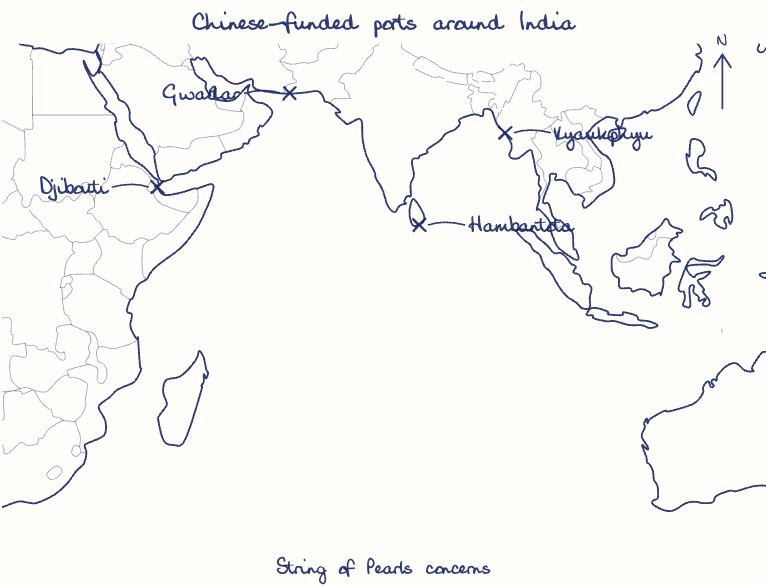
Belt and Road loans built Gwadar and Hambantota (leased for 99 years in 2017) and are developing Kyaukphyu, alongside the Djibouti base (2017).
Leverage through dependence
Debt and market access make partners reluctant to oppose Beijing, as Sri Lanka's 2022 debt crisis exposed.
Strategic encirclement
Chinese-funded ports in Pakistan, Sri Lanka and Myanmar raise "String of Pearls" concerns in the Indian Ocean, India's maritime backyard.
Two-front threat
China supplied about 81 percent of Pakistan's arms imports in 2020-24 (SIPRI, 2025), and CPEC crosses Pakistan-occupied Kashmir.
Economic vulnerability
India's deficit with China was about US$99 billion in 2024-25, and 2025 curbs on rare earth magnets hit Indian automakers.
Spur to self-reliance
India responded with Press Note 3 (2020) screening of Chinese investment, PLI schemes, the Quad and SAGAR.
This model answer is indicative and the model can make mistakes; please verify key facts independently.
Practise this question
1Get the answer sheet
Sized for this question.
2Write your answer
Timed, by hand.
3Get it marked
Your score and what to fix.
This chapter in the exam
Neighbourhood Relations13 questions
Asked in 7 of 14 sittings since 2013
- 2026“China’s Belt and Road Initiative (BRI) has transformed South Asia from a regional space into a theatre of great power competition.” Analyse the strategic implications of the BRI for India’s security and regional influence in South Asia.
- 2024Discuss the geopolitical and geostrategic importance of Maldives for India with a focus on global trade and energy flows. Further also discuss how this relationship affects India's maritime security and regional stability amidst international competition ?
All 13 questions, sorted by sub-topic, with model answers and practice.
Question from the official UPSC Civil Services (Main) Examination 2017 paper. Answer written by Ghissu's engine and checked against our editorial standards. Found an error? Tell us and we correct it within 48 hours.