2017 · GS Paper 2 · Q2 · 10 marks
Critically examine the Supreme Court's judgement on National Judicial Appointments Commission Act, 2014 with reference to appointment of judges of higher judiciary in India.
In short
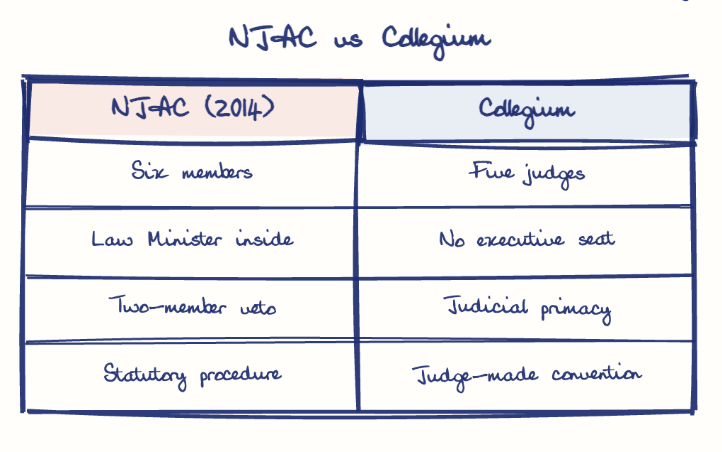
The Supreme Court rightly struck down the NJAC in 2015 to protect judicial primacy and independence, but it preserved an opaque collegium it admitted was flawed. A central flaw it found was that any two NJAC members, including the Law Minister, could veto all three judges.
Model answer
Ghissu Editorial · Verified 4 Oct 2026 · 284 words
Primacy as independence
The majority held that judicial primacy in appointments is part of judicial independence, a basic feature, so the amendment failed the Kesavananda Bharati (1973) test.
Executive in the room
The Law Minister's seat risked reciprocity, since the government is the largest litigant before the courts.
Veto by non-judges
Any two members could block a candidate, so the minister and two undefined "eminent persons" could override all three judges.
Text versus primacy
Articles 124(2) and 217 require only "consultation"; primacy was read in by the 1993 judgment.
Chelameswar's dissent
Justice J. Chelameswar held that collegium opacity, not executive participation, was the real threat to credibility.
Accountability gap
The Court conceded the collegium's flaws and sought a revised Memorandum of Procedure, still disputed; online resolutions since 2017 do not explain choices.
Narrow bench
The Law Ministry told a parliamentary panel in 2023 that about 79% of High Court judges appointed since 2018 were from the general category.
This model answer is indicative and the model can make mistakes; please verify key facts independently.
Practise this question
1Get the answer sheet
Sized for this question.
2Write your answer
Timed, by hand.
3Get it marked
Your score and what to fix.
This chapter in the exam
Structure, Organization and Functioning of the Union Judiciary7 questions
Asked in 7 of 14 sittings since 2013
- 2026What is meant by judicial legislation ? In this context, discuss the verdicts of the apex court allowing “passive euthanasia” and a “living will”.
- 2024Explain the reasons for the growth of public interest litigation in India. As a result of it, has the Indian Supreme Court emerged as the world's most powerful judiciary?
All 7 questions, sorted by sub-topic, with model answers and practice.
Question from the official UPSC Civil Services (Main) Examination 2017 paper. Answer written by Ghissu's engine and checked against our editorial standards. Found an error? Tell us and we correct it within 48 hours.