2017 · GS Paper 2 · Q11 · 15 marks
Explain the salient features of the constitution One Hundred and First Amendment Act, 2016. Do you think it is efficacious enough to remove cascading effect of taxes and provide for common national market for goods and services?
In short
The 101st Amendment Act, 2016 created GST through concurrent taxing power, destination-based IGST and the GST Council, and it has largely removed cascading and internal tax barriers. Petroleum, aviation fuel and electricity remain outside GST, so the common national market is still incomplete.
Model answer
Ghissu Editorial · Verified 4 Oct 2026 · 296 words
Concurrent power
Article 246A lets Parliament and states tax the same supply, with Parliament alone taxing inter-state supplies.
IGST and Council
Article 269A provides destination-based IGST, and Article 279A creates the GST Council with two-thirds voting weight for states and a three-fourths decision rule.
Subsumption and compensation
Entries 92 and 92C of the Union List and 52 and 55 of the State List were deleted, alcohol was excluded, and states were promised five years of compensation.
Credit chain restored
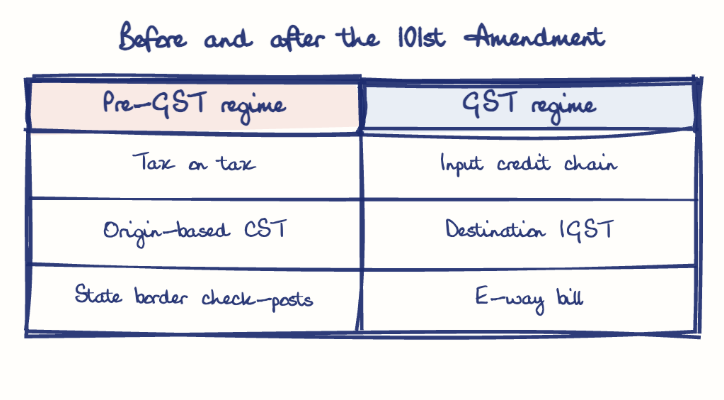
Input tax credit flows across goods, services and states, and e-way bills from April 2018 replaced check-posts.
Gaps remain
Petroleum, aviation fuel and electricity stay outside GST, credits blocked under Section 17(5) still cascade, and multiple slabs caused inverted duties until the September 2025 move to 5% and 18% with a 40% de-merit rate.
Fragmented compliance
Multi-state firms still register separately in every state, and appeals waited years for a tribunal.
Complete the reform
Phase in natural gas and aviation fuel under Article 279A(5), allow centralised registration for multi-state firms, and make the GST Appellate Tribunal fully functional.
This model answer is indicative and the model can make mistakes; please verify key facts independently.
Practise this question
1Get the answer sheet
Sized for this question.
2Write your answer
Timed, by hand.
3Get it marked
Your score and what to fix.
This chapter in the exam
Amendments & Basic Structure4 questions
Asked in 4 of 14 sittings since 2013
- 2025Indian Constitution has conferred the amending power on the ordinary legislative institutions with a few procedural hurdles. In view of this statement, examine the procedural and substantive limitations on the amending power of the Parliament to change the Constitution.
- 2023Explain the significance of the 101st Constitutional Amendment Act. To what extent does it reflect the accommodative spirit of federalism?
All 4 questions, sorted by sub-topic, with model answers and practice.
Question from the official UPSC Civil Services (Main) Examination 2017 paper. Answer written by Ghissu's engine and checked against our editorial standards. Found an error? Tell us and we correct it within 48 hours.