2023 · GS Paper 2 · Q15 · 15 marks
Explain the significance of the 101st Constitutional Amendment Act. To what extent does it reflect the accommodative spirit of federalism?
In short
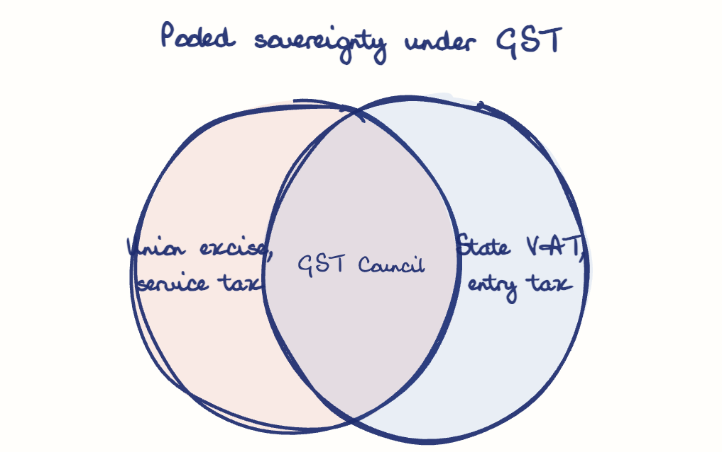
The 101st Amendment Act, 2016 created GST by giving the Union and states concurrent taxing power and a joint GST Council, reflecting accommodative federalism largely in design. States hold two-thirds of the Council's voting weight, though the Centre's one-third share works as an effective veto.
Model answer
Ghissu Editorial · Verified 4 Oct 2026 · 264 words
Concurrent power
Article 246A lets Parliament and states tax the same supply, ending the separation of tax fields.
Unified market
Central excise, service tax, VAT and entry tax merged into one levy, and Article 269A's destination-based IGST replaced the Central Sales Tax.
Federal institution
Article 279A created the GST Council of the Union and all state Finance Ministers.
Shared voting
States hold two-thirds weight, the Centre one-third, decisions need three-fourths, and the Council has voted formally only once (lottery, December 2019).
Compensation and courts
States were assured 14% revenue growth for five years, and Mohit Minerals (2022) held Council recommendations persuasive, not binding.
Centralising tilt
The Centre's weight is a de facto veto, the 2020 compensation shortfall caused friction, and the Article 279A(11) dispute mechanism is not yet set up.
Institutional fixes
A working dispute mechanism, an independent Council secretariat and a negotiated path to include petroleum would deepen trust.
This model answer is indicative and the model can make mistakes; please verify key facts independently.
Practise this question
1Get the answer sheet
Sized for this question.
2Write your answer
Timed, by hand.
3Get it marked
Your score and what to fix.
This chapter in the exam
Amendments & Basic Structure4 questions
Asked in 4 of 14 sittings since 2013
- 2025Indian Constitution has conferred the amending power on the ordinary legislative institutions with a few procedural hurdles. In view of this statement, examine the procedural and substantive limitations on the amending power of the Parliament to change the Constitution.
- 2019Parliament's power to amend the Constitution is a limited power and it cannot be enlarged into absolute power. In the light of this statement explain whether Parliament under Article 368 of the Constitution can destroy the Basic Structure of the Constitution by expanding its amending power.
All 4 questions, sorted by sub-topic, with model answers and practice.
Question from the official UPSC Civil Services (Main) Examination 2023 paper. Answer written by Ghissu's engine and checked against our editorial standards. Found an error? Tell us and we correct it within 48 hours.