2017 · GS Paper 2 · Q8 · 10 marks
Hunger and poverty are the biggest challenges for good governance in India still today. Evaluate how far successive governments have progressed in dealing with these humongous problems. Suggest measures for improvement.
In short
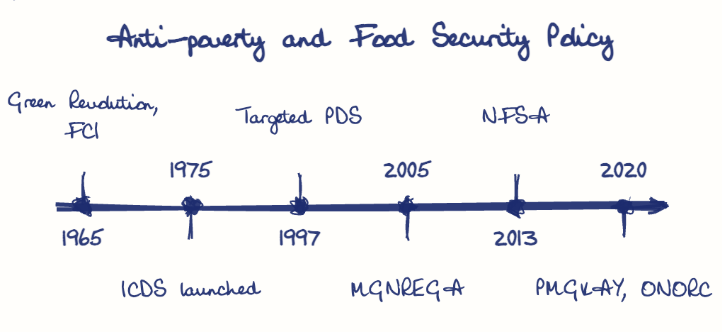
Successive governments have largely ended famine and sharply reduced income poverty through food self-sufficiency, MGNREGA and the rights-based NFSA, but nutrition security still lags. NITI Aayog estimates that 24.82 crore people escaped multidimensional poverty between 2013-14 and 2022-23, yet NFHS-5 found 35.5% of children stunted.
Model answer
Ghissu Editorial · Verified 4 Oct 2026 · 293 words
Poverty falls steeply
Poverty on the Tendulkar line fell from 37.2% in 2004-05 to 21.9% in 2011-12, and NITI Aayog estimates that 24.82 crore people escaped multidimensional poverty between 2013-14 and 2022-23.
Rights-based food security
The NFSA 2013 made subsidised grain a legal entitlement, and PMGKAY now gives free grain to 81 crore people till December 2028.
Nutrition lags behind
NFHS-5 (2019-21) still found 35.5% of children stunted, and the Shanta Kumar Committee (2015) estimated 40-50% PDS leakage, so calorie security has not become nutrition security.
Nutrition-sensitive PDS
Add pulses, millets and fortified rice to the ration basket under POSHAN 2.0, so cheap calories also carry protein.
Plug leakages
Extend One Nation One Ration Card and end-to-end computerisation to every migrant household.
Livelihood graduation
Link MGNREGA, DAY-NRLM credit and skilling, as Kerala's Kudumbashree shows, so families move from transfers to incomes.
Outcome monitoring
Track stunting and multidimensional poverty district-wise through the Poshan Tracker and reward States on outcomes.
This model answer is indicative and the model can make mistakes; please verify key facts independently.
Practise this question
1Get the answer sheet
Sized for this question.
2Write your answer
Timed, by hand.
3Get it marked
Your score and what to fix.
This chapter in the exam
Poverty and Hunger4 questions
Asked in 4 of 14 sittings since 2013
- 2024Poverty and malnutrition create a vicious cycle, adversely affecting human capital formation. What steps can be taken to break the cycle ?
- 2019There is a growing divergence in the relationship between poverty and hunger in India. The shrinking of social expenditure by the government is forcing the poor to spend more on non-food essential items squeezing their food-budget. — Elucidate.
All 4 questions, sorted by sub-topic, with model answers and practice.
Question from the official UPSC Civil Services (Main) Examination 2017 paper. Answer written by Ghissu's engine and checked against our editorial standards. Found an error? Tell us and we correct it within 48 hours.