2017 · GS Paper 2 · Q17 · 15 marks
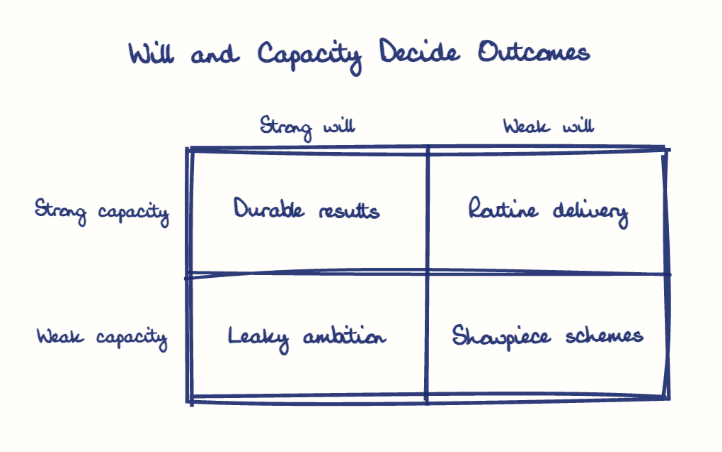
"Poverty alleviation programmes in India remain mere showpieces until and unless they are backed up by political will." Discuss with reference to the performance of the major poverty alleviation programmes in India.
In short
Poverty programmes in India have succeeded where political will was matched by delivery capacity and community oversight, and stayed showpieces where it was not. Chhattisgarh's PDS reform cut leakages sharply, while the Shanta Kumar Committee (2015) estimated that 46% of PDS grain leaked nationally.
Model answer
Ghissu Editorial · Verified 4 Oct 2026 · 281 words
Chhattisgarh PDS
From 2004 the state took ration shops from private dealers and computerised supply, cutting leakages to among the lowest in India.
MGNREGA and SHGs
Andhra Pradesh's social audits kept the job guarantee honest, the scheme gave a record 389 crore person-days in 2020-21, and DAY-NRLM has organised about 10 crore women into SHGs.
DBT outcomes
Over ₹53 lakh crore moved through DBT since 2013, and NITI Aayog estimates multidimensional poverty fell from 29.17% (2013-14) to 11.28% (2022-23).
Leakage
The Shanta Kumar Committee (2015) estimated 46% of PDS grain leaked, and IRDP loans in the 1980s were often written off at election time.
Funding and exclusion
The Supreme Court in Swaraj Abhiyan (2018) censured delayed MGNREGA wages, and Santoshi Kumari's hunger death in Jharkhand (2017) showed that technology without grievance redress excludes the poorest.
Credible funding
Pay MGNREGA wages within a fortnight and budget for real demand.
Community oversight
Make social audits statutory everywhere, following Meghalaya's 2017 law, and track district outcomes publicly.
This model answer is indicative and the model can make mistakes; please verify key facts independently.
Practise this question
1Get the answer sheet
Sized for this question.
2Write your answer
Timed, by hand.
3Get it marked
Your score and what to fix.
This chapter in the exam
Poverty4 questions
Asked in 4 of 14 sittings since 2013
- 2025Inequality in the ownership pattern of resources is one of the major causes of poverty. Discuss in the context of 'paradox of poverty'.
- 2020"The incidence and intensity of poverty are more important in determining poverty based on income alone". In this context analyse the latest United Nations Multidimensional Poverty Index Report.
All 4 questions, sorted by sub-topic, with model answers and practice.
Question from the official UPSC Civil Services (Main) Examination 2017 paper. Answer written by Ghissu's engine and checked against our editorial standards. Found an error? Tell us and we correct it within 48 hours.