2025 · GS Paper 2 · Q16 · 15 marks
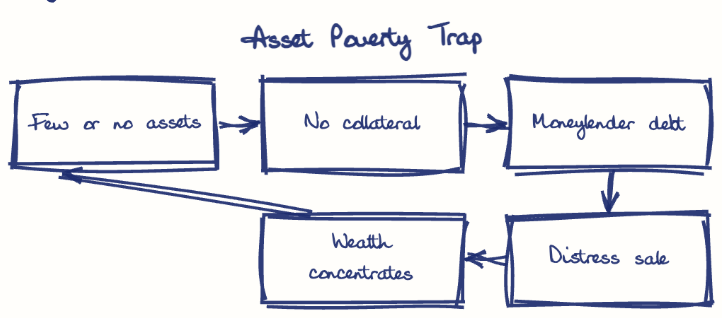
Inequality in the ownership pattern of resources is one of the major causes of poverty. Discuss in the context of 'paradox of poverty'.
In short
Unequal ownership of land, capital and skills is a major cause of poverty and explains the paradox of deprivation amid abundant food, minerals and growth. India's top 1% held about 40% of national wealth in 2023, while small and marginal farmers operate only about 47% of farm area.
Model answer
Ghissu Editorial · Verified 4 Oct 2026 · 287 words
Land
Small and marginal farmers hold about 86% of holdings but only about 47% of the area (Agriculture Census 2015-16), and the SECC 2011 found 56% of rural households landless.
Gender and caste
Women are only 13.9% of operational holders, and Dalit households remain concentrated in casual labour.
Capital and skills
Returns to capital outpace wages (Piketty's r > g), and the better-off buy schooling and health the poor cannot.
Resource curse
Mineral-rich Jharkhand had about 29% of people multidimensionally poor in 2019-21 (NITI Aayog), with Adivasis displaced while mining rents flow elsewhere.
Granaries and hunger
In PUCL (2001) grain rotted in FCI godowns amid starvation, and Sen showed the 1943 Bengal famine was an entitlement failure, not a food shortage.
Other causes
Extreme poverty fell from 16.2% to 2.3% (World Bank, 2011-12 to 2022-23) despite concentration, so low-productivity jobs and health shocks matter too.
Secure ownership
Digitise land records under SVAMITVA, enforce the Forest Rights Act 2006 and route royalties through District Mineral Foundations.
Women's titles
Register houses and land in women's names.
This model answer is indicative and the model can make mistakes; please verify key facts independently.
Practise this question
1Get the answer sheet
Sized for this question.
2Write your answer
Timed, by hand.
3Get it marked
Your score and what to fix.
This chapter in the exam
Poverty4 questions
Asked in 4 of 14 sittings since 2013
- 2020"The incidence and intensity of poverty are more important in determining poverty based on income alone". In this context analyse the latest United Nations Multidimensional Poverty Index Report.
- 2017"Poverty alleviation programmes in India remain mere showpieces until and unless they are backed up by political will." Discuss with reference to the performance of the major poverty alleviation programmes in India.
All 4 questions, sorted by sub-topic, with model answers and practice.
Question from the official UPSC Civil Services (Main) Examination 2025 paper. Answer written by Ghissu's engine and checked against our editorial standards. Found an error? Tell us and we correct it within 48 hours.