2017 · GS Paper 2 · Q13 · 15 marks
The Indian Constitution has provisions for holding joint session of the two houses of the Parliament. Enumerate the occasions when this would normally happen and also the occasions when it cannot, with reasons thereof.
In short
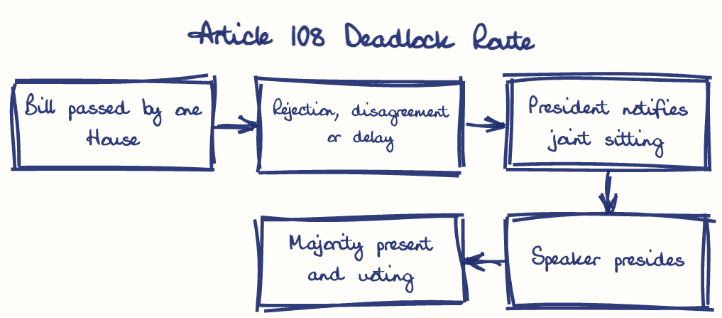
A joint sitting under Article 108 is held when one House rejects an ordinary or financial bill, the Houses disagree on amendments, or six months pass without action. It is barred for Money Bills and Constitutional Amendment Bills, where Lok Sabha primacy or separate federal consent applies.
Model answer
Ghissu Editorial · Verified 4 Oct 2026 · 302 words
Rejection or disagreement
When the second House rejects an ordinary bill or the Houses finally disagree on amendments, Article 108(1) opens a joint sitting, as with POTA in 2002, and disputed amendments alone are taken up under Article 108(4).
Six months of inaction
Delay beyond six months, excluding prorogation, counts as deadlock, and the Lok Sabha's larger numbers usually prevail in the joint vote.
Financial bills
Bills under Article 117(1) and 117(3) follow the ordinary route and can also go to a joint sitting.
Special address
Under Article 87 both Houses also assemble together for the President's address each year, without any vote.
Money Bills
Under Article 109 the Rajya Sabha only recommends within 14 days, so no deadlock can arise.
Constitutional amendments
Article 368 needs separate special majorities so the Council of States keeps its federal veto.
Lapsed bills
A bill lapsed on dissolution before notification cannot bind a new House.
Separate resolutions
Emergency approval (Article 352), impeachment (Article 61) and removal of judges need two independent verdicts.
This model answer is indicative and the model can make mistakes; please verify key facts independently.
Practise this question
1Get the answer sheet
Sized for this question.
2Write your answer
Timed, by hand.
3Get it marked
Your score and what to fix.
This chapter in the exam
Parliament — Conduct of Business5 questions
Asked in 4 of 14 sittings since 2013
- 2023Explain the structure of the Parliamentary Committee system. How far have the financial committees helped in the institutionalisation of Indian Parliament?
- 2021Do Department-related Parliamentary Standing Committees keep the administration on its toes and inspire reverence for parliamentary control? Evaluate the working of such committees with suitable examples.
All 5 questions, sorted by sub-topic, with model answers and practice.
Question from the official UPSC Civil Services (Main) Examination 2017 paper. Answer written by Ghissu's engine and checked against our editorial standards. Found an error? Tell us and we correct it within 48 hours.