2021 · GS Paper 2 · Q15 · 15 marks
Do Department-related Parliamentary Standing Committees keep the administration on its toes and inspire reverence for parliamentary control? Evaluate the working of such committees with suitable examples.
In short
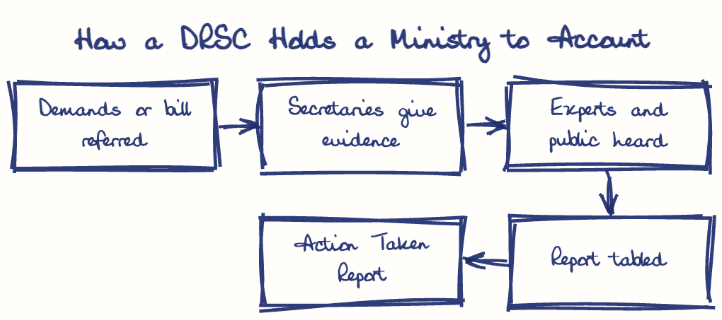
Department-related Standing Committees keep the administration on its toes only partially: they scrutinise grants and bills on evidence, but are often bypassed and their reports only advise. PRS found that only 16% of bills were referred to committees in the 17th Lok Sabha.
Model answer
Ghissu Editorial · Verified 4 Oct 2026 · 285 words
Scrutiny of grants
They examine demands for grants, vital when about 80% of the budget passed without discussion in 2019-2023 (PRS).
Improving bills
The Law and Justice Committee reshaped the Lokpal Bill in 2011, and the Finance Committee's 2012 report corrected the Direct Taxes Code draft.
Questioning policy
The Agriculture Committee's 2012 report on GM crops and the Health Committee's 2020 Covid-19 report tested government on evidence.
Bypassed on major laws
The 2020 farm laws skipped committee scrutiny, making referral an option rather than a rule.
Advisory reports
Ministries reply late or selectively in Action Taken Notes.
Partisan breakdown
The IT Committee's Pegasus meeting failed for want of quorum in July 2021.
Thin capacity
One-year terms and little research staff weaken expertise.
Reform the rules
Mandatory referral, longer tenure, research staff and House debate on reports, on the lines of the UK's Wright reforms (2010).
This model answer is indicative and the model can make mistakes; please verify key facts independently.
Practise this question
1Get the answer sheet
Sized for this question.
2Write your answer
Timed, by hand.
3Get it marked
Your score and what to fix.
This chapter in the exam
Parliament — Conduct of Business5 questions
Asked in 4 of 14 sittings since 2013
- 2023Explain the structure of the Parliamentary Committee system. How far have the financial committees helped in the institutionalisation of Indian Parliament?
- 2018Why do you think the committees are considered to be useful for parliamentary work? Discuss, in this context, the role of the Estimates Committee.
All 5 questions, sorted by sub-topic, with model answers and practice.
Question from the official UPSC Civil Services (Main) Examination 2021 paper. Answer written by Ghissu's engine and checked against our editorial standards. Found an error? Tell us and we correct it within 48 hours.