2017 · GS Paper 2 · Q14 · 15 marks
To enhance the quality of democracy in India the Election Commission of India has proposed electoral reforms in 2016. What are the suggested reforms and how far are they significant to make democracy successful?
In short
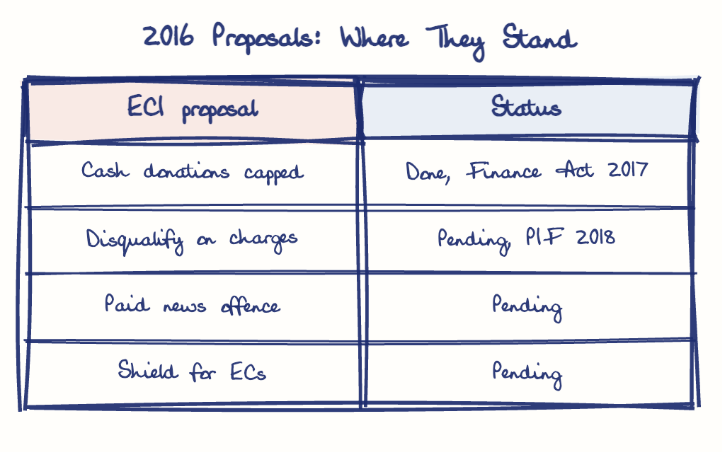
The ECI's 2016 proposals sought to bar charge-sheeted candidates, clean party funding, criminalise paid news and shield Election Commissioners, which would make elections fairer as well as free. Only the ₹2,000 cap on anonymous cash donations became law, in the Finance Act 2017.
Model answer
Ghissu Editorial · Verified 4 Oct 2026 · 310 words
Article 324 gives the Election Commission control of elections, but only Parliament can change electoral law. In December 2016 the ECI sent the Law Ministry a package of proposals to amend the Representation of the People Act, 1951.
Electoral Reforms Suggested by the ECI in 2016
1. Decriminalisation: Bar candidates charged with offences punishable by five years or more, and make a false affidavit punishable with two years and disqualification. 2. Party funding: Ban anonymous donations of ₹2,000 and above and empower the ECI to deregister paper parties. 3. Inducements: Make paid news an electoral offence and bribery cognisable; stop government publicity ads six months before a term ends. 4. Institutional strength: Equal removal protection for ECs, an independent secretariat, contempt powers, totalisers and one candidate, one seat.
Purer representation
ADR finds 46% of MPs elected in 2024 declaring criminal cases; charge-stage disqualification would act at the source, if guarded against motivated cases.
Clean money
The ₹2,000 cash cap came in 2017, but electoral bonds, struck down in ADR v. Union of India (2024), show partial reform shifts opacity.
Trusted umpire
Removal protection for ECs would complete Anoop Baranwal (2023), which the 2023 appointment law diluted.
One comprehensive Bill
Enact the package with fast-track courts and an Article 324(5) amendment.
This model answer is indicative and the model can make mistakes; please verify key facts independently.
Practise this question
1Get the answer sheet
Sized for this question.
2Write your answer
Timed, by hand.
3Get it marked
Your score and what to fix.
This chapter in the exam
Constitutional Bodies14 questions
Asked in 9 of 14 sittings since 2013
- 2026Is the right to vote a fundamental right ? Discuss the position of the Election Commission of India while undertaking the revision of electoral rolls. Can it also examine the question of citizenship of voters ?
- 2026Do constitutional bodies like the National Commission for Scheduled Castes (NCSC) and the National Commission for Scheduled Tribes (NCST) possess adequate enforcement powers to secure substantive social equality ? Suggest measures to enhance their institutional effectiveness.
All 14 questions, sorted by sub-topic, with model answers and practice.
Question from the official UPSC Civil Services (Main) Examination 2017 paper. Answer written by Ghissu's engine and checked against our editorial standards. Found an error? Tell us and we correct it within 48 hours.