2026 · GS Paper 2 · Q5 · 10 marks
Do constitutional bodies like the National Commission for Scheduled Castes (NCSC) and the National Commission for Scheduled Tribes (NCST) possess adequate enforcement powers to secure substantive social equality ? Suggest measures to enhance their institutional effectiveness.
In short
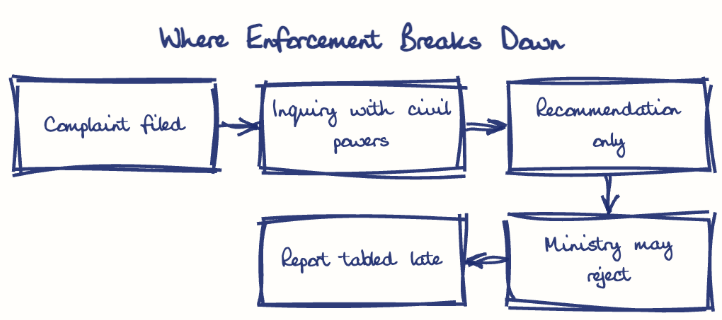
The NCSC and NCST hold civil court powers to investigate and a right to be consulted, but their recommendations bind no one, so their enforcement powers are inadequate for substantive equality. The Environment Ministry rejected the NCST's 2022 plea to hold the Forest Conservation Rules.
Model answer
Ghissu Editorial · Verified 4 Oct 2026 · 280 words
Civil court powers
Under Articles 338(8) and 338A(8) they can summon persons and requisition records.
Mandatory consultation
The Union and States must consult them on major policies under Articles 338(9) and 338A(9).
Parliamentary reporting
Their reports go to Parliament with action-taken memoranda, and they take up atrocity cases under the 1989 Act.
Advice, not orders
They cannot penalise or compel; the Environment Ministry rejected the NCST's 2022 plea to hold the Forest Conservation Rules, 2022 for diluting gram sabha consent.
Toothless consultation
Nothing invalidates a policy framed without consulting them, so the duty is often a formality.
Dependent and delayed
Vacancies, ministry-controlled budgets and late tabling blunt their reports.
Binding timelines
Ministries should accept or reject recommendations with reasons within a fixed period.
Power to approach courts
Give them the NHRC's Section 18 power to seek writs.
Independence
Broad-based selection, an own secretariat and budget, and an annual district-level safeguards audit.
This model answer is indicative and the model can make mistakes; please verify key facts independently.
Practise this question
1Get the answer sheet
Sized for this question.
2Write your answer
Timed, by hand.
3Get it marked
Your score and what to fix.
This chapter in the exam
Constitutional Bodies14 questions
Asked in 9 of 14 sittings since 2013
- 2026Is the right to vote a fundamental right ? Discuss the position of the Election Commission of India while undertaking the revision of electoral rolls. Can it also examine the question of citizenship of voters ?
- 2025The Attorney General of India plays a crucial role in guiding the legal framework of the Union Government and ensuring sound governance through legal counsel. Discuss his responsibilities, rights and limitations in this regard.
All 14 questions, sorted by sub-topic, with model answers and practice.
Question from the official UPSC Civil Services (Main) Examination 2026 paper. Answer written by Ghissu's engine and checked against our editorial standards. Found an error? Tell us and we correct it within 48 hours.