2017 · GS Paper 3 · Q4 · 10 marks
Explain various types of revolutions, took place in Agriculture after independence in India. How these revolutions have helped in poverty alleviation and food security in India ?
In short
Post-independence revolutions in grain (Green), milk (White), oilseeds, horticulture, fisheries and eggs turned India food-surplus, built the buffer stock behind the NFSA and raised rural incomes. Foodgrain output reached a record 357.73 million tonnes in 2024-25, though gains bypassed rain-fed regions.
Model answer
Ghissu Editorial · Verified 4 Oct 2026 · 278 words
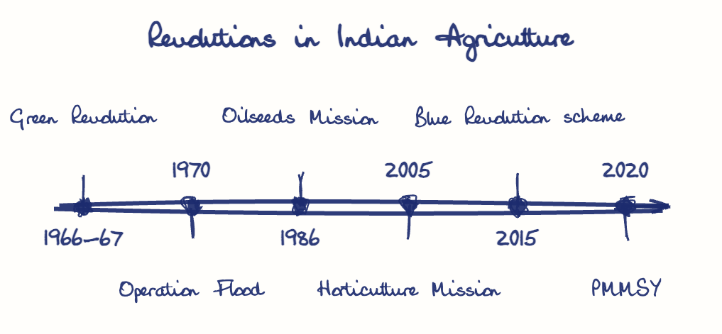
Green Revolution (1966-67)
HYV wheat and rice, irrigation, fertiliser and MSP procurement, championed by M.S. Swaminathan, transformed Punjab, Haryana and western Uttar Pradesh.
White Revolution (1970)
Operation Flood under Verghese Kurien and the NDDB built a cooperative milk grid; milk output reached 247.87 million tonnes in 2024-25 (DAHD).
Yellow and Golden Revolutions
The Technology Mission on Oilseeds (1986) and the horticulture push took fruit and vegetable output to 362.08 million tonnes in 2024-25.
Blue, Silver and Pink Revolutions
Fisheries (Blue Revolution scheme 2015, PMMSY 2020), eggs and meat processing diversified rural livelihoods and diets.
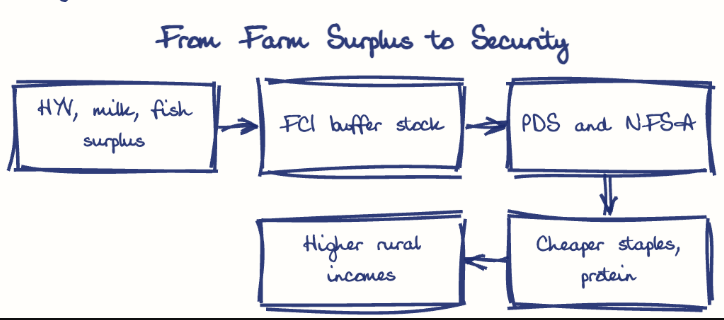
Food availability
Surpluses built the buffer stock behind the NFSA 2013 and free grain for about 81 crore people under PMGKAY.
Incomes and wages
Higher yields raised farm wages, and dairy cooperatives gave landless and women-led households steady cash income.
Nutrition
Milk availability rose to 471 grams per person a day in 2023-24 (BAHS 2024).
Uneven gains
Rain-fed eastern India and pulses were bypassed, and Punjab's groundwater was depleted, so poverty fell faster in irrigated regions.
This model answer is indicative and the model can make mistakes; please verify key facts independently.
Practise this question
1Get the answer sheet
Sized for this question.
2Write your answer
Timed, by hand.
3Get it marked
Your score and what to fix.
This chapter in the exam
Technology Missions3 questions
Asked in 3 of 14 sittings since 2013
- 2026Describe the various Technology Missions initiated in Indian agriculture and examine their role in food security. (Answer in 150 words)
- 2018Assess the role of National Horticulture Mission (NHM) in boosting the production, productivity and income of horticulture farms. How far has it succeeded in increasing the income of farmers?
Question from the official UPSC Civil Services (Main) Examination 2017 paper. Answer written by Ghissu's engine and checked against our editorial standards. Found an error? Tell us and we correct it within 48 hours.