2018 · GS Paper 3 · Q13 · 15 marks
Assess the role of National Horticulture Mission (NHM) in boosting the production, productivity and income of horticulture farms. How far has it succeeded in increasing the income of farmers?
In short
The National Horticulture Mission lifted horticulture production through planting material, protected cultivation and post-harvest support, but raised farmers' incomes only partially because of yield lag, post-harvest losses and price crashes. Output rose from 280.70 million tonnes in 2013-14 to 362.08 million tonnes in 2024-25.
Model answer
Ghissu Editorial · Verified 4 Oct 2026 · 269 words
Yield at the root
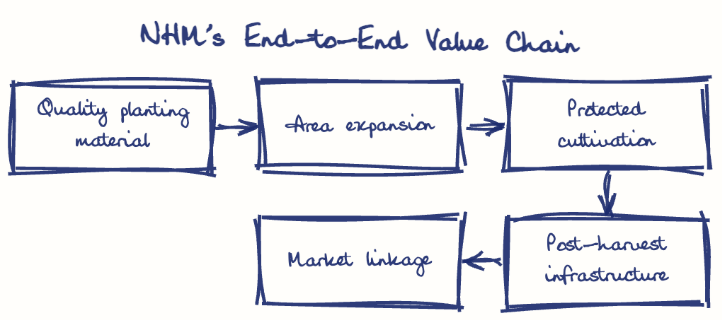
Nurseries, tissue culture and rejuvenation of senile orchards replaced low-yielding stock.
High-tech farming
Polyhouses, drip irrigation and Indo-Israel Centres of Excellence such as Gharaunda spread high-value cultivation.
Output over yield
Production rose from 280.70 million tonnes (2013-14) to 362.08 million tonnes (2024-25), but fruit yields rose only from 14.17 to 15.80 tonnes per hectare (2014-15 to 2023-24).
Value per hectare
Fruits and vegetables earn several times more per hectare than cereals, so diversifying growers, like Nashik's grape farmers, gained clearly.
Post-harvest leakage
ICAR-CIPHET (2015) estimated losses of 6.7-15.9% for fruits and 4.6-12.4% for vegetables, eroding gains before produce reaches a buyer.
Price crashes and scale bias
Nashik's 2018 onion crash and potato-dominated cold storage show that gains reach those with storage, not the 86% who are small and marginal.
FPOs and cold chains
Route support through the 10,000 FPO scheme (2020) and build cluster cold chains with the Agriculture Infrastructure Fund.
Yield over area
Scale the Clean Plant Programme (2024) so growth comes from productivity.
This model answer is indicative and the model can make mistakes; please verify key facts independently.
Practise this question
1Get the answer sheet
Sized for this question.
2Write your answer
Timed, by hand.
3Get it marked
Your score and what to fix.
This chapter in the exam
Technology Missions3 questions
Asked in 3 of 14 sittings since 2013
- 2026Describe the various Technology Missions initiated in Indian agriculture and examine their role in food security. (Answer in 150 words)
- 2017Explain various types of revolutions, took place in Agriculture after independence in India. How these revolutions have helped in poverty alleviation and food security in India ?
Question from the official UPSC Civil Services (Main) Examination 2018 paper. Answer written by Ghissu's engine and checked against our editorial standards. Found an error? Tell us and we correct it within 48 hours.