2017 · GS Paper 3 · Q16 · 15 marks
Give an account of the growth and development of nuclear science and technology in India. What is the advantage of fast breeder reactor programme in India ?
In short
India has grown from the Apsara research reactor (1956) to a largely indigenous nuclear ecosystem of PHWRs, fuel-cycle mastery and about 8.78 GW of capacity. Its fast breeder programme, led by the 500 MWe PFBR at Kalpakkam, breeds fuel and unlocks thorium.
Model answer
Ghissu Editorial · Verified 4 Oct 2026 · 281 words
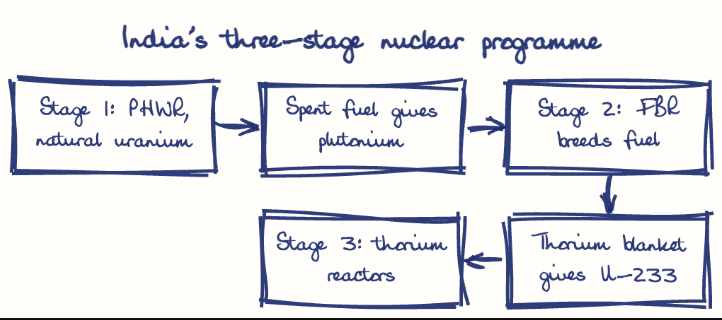
Homi Bhabha's three-stage programme aimed to convert India's modest uranium and abundant thorium into lasting energy security; India now runs about 8.78 GW of nuclear capacity (PIB, 2025) and targets 100 GW by 2047.
Growth of Nuclear Science and Technology in India
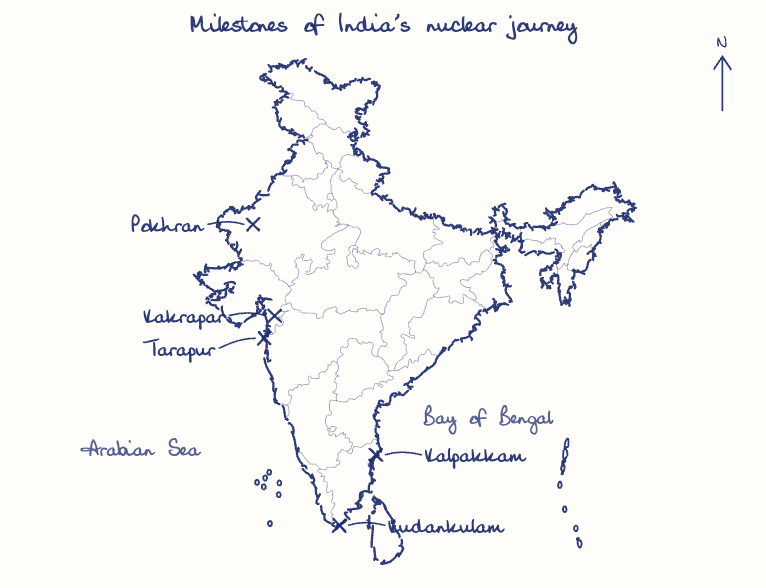
1. Foundations: The AEC (1948), DAE (1954) and BARC gave Asia its first research reactor, Apsara (1956), and the Tarapur power station (1969). 2. Indigenous reactors: After Pokhran-I (1974) brought sanctions, India scaled PHWRs from 220 MWe to 700 MWe at Kakrapar-3 (2021) and mastered heavy water, reprocessing and the Fast Breeder Test Reactor (1985). 3. Diversification: The 2008 NSG waiver enabled Kudankulam, INS Arihant (2016) added propulsion, and BARC's Bhabhatron and crop varieties took the atom to health and farming.
Breeds fuel
The 500 MWe PFBR at Kalpakkam, core-loaded in March 2024, converts uranium-238 into plutonium, multiplying energy from the same uranium.
Thorium gateway
Its thorium blanket yields uranium-233, unlocking India's vast thorium reserves.
Less waste, more security
It burns plutonium and depleted uranium from PHWR spent fuel, shrinking long-lived waste and reducing dependence on imported uranium.
Scale with reforms
Use the SHANTI Act (2025) and the Rs 20,000 crore SMR mission to bring in private capital, with an independent regulator to build trust.
This model answer is indicative and the model can make mistakes; please verify key facts independently.
Practise this question
1Get the answer sheet
Sized for this question.
2Write your answer
Timed, by hand.
3Get it marked
Your score and what to fix.
This chapter in the exam
Developments, Applications and Effects in Everyday Life23 questions
Asked in 13 of 14 sittings since 2013
- 2026Distinguish between a Fast Breeder Reactor (FBR) and a thermal nuclear reactor. In the context of first indigenously developed prototype FBR at Kalpakkam, explain the term 'criticality'. What are its implications for clean energy future of our country? (Answer in 150 words)
- 2025How can India achieve energy independence through clean technology by 2047 ? How can biotechnology play a crucial role in this endeavour ?
All 23 questions, sorted by sub-topic, with model answers and practice.
Question from the official UPSC Civil Services (Main) Examination 2017 paper. Answer written by Ghissu's engine and checked against our editorial standards. Found an error? Tell us and we correct it within 48 hours.