2017 · GS Paper 3 · Q15 · 15 marks
How do subsidies affect the cropping pattern, crop diversity and economy of farmers ? What is the significance of crop insurance, minimum support price and food processing for small and marginal farmers ?
In short
Input and price subsidies have locked Indian farms into a water-hungry paddy-wheat pattern, eroded crop diversity and favoured large farmers, while insurance, MSP and processing protect smallholders from ruin, distress sale and waste. The Shanta Kumar Committee (2015) found only about 6% of farmers selling at MSP.
Model answer
Ghissu Editorial · Verified 4 Oct 2026 · 281 words
Skewed Cropping Pattern
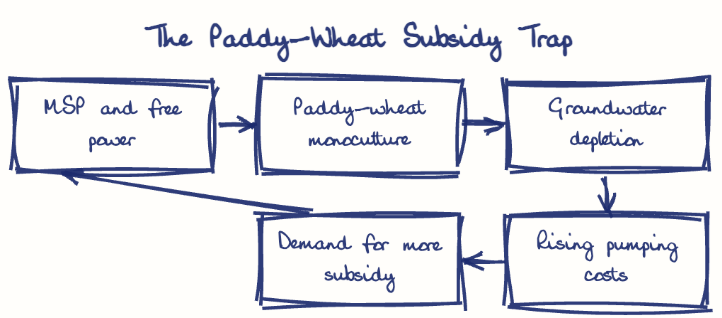
MSP procurement, free power and cheap urea locked Punjab and Haryana into paddy and wheat, draining groundwater.
Loss of Crop Diversity
Pulses, millets and oilseeds lost area, raising edible-oil imports and pushing coarse grains out of diets.
Mixed Farm Economics
Subsidies helped foodgrain output reach 357.7 million tonnes in 2024-25, but cheap urea skews the NPK ratio, soils degrade and large farmers capture most gains.
Crop Insurance
PMFBY caps the premium at 2% for kharif and insured 4.19 crore farmers in 2024-25 (PIB, 2025), saving smallholders from one-season ruin.
Minimum Support Price
MSP prevents distress sale, though the Shanta Kumar Committee (2015) found only about 6% of farmers selling at it.
Food Processing
Cutting post-harvest losses, about ₹92,651 crore a year (ICAR-CIPHET, 2015), and the Amul model raise farmers' share of the consumer rupee.
Crop-Neutral Support
Shift to per-acre income support and reward diversification, as Haryana's Mera Pani Meri Virasat (2020) does.
Collective Access
Link FPOs to procurement, insurance and processing clusters.
This model answer is indicative and the model can make mistakes; please verify key facts independently.
Practise this question
1Get the answer sheet
Sized for this question.
2Write your answer
Timed, by hand.
3Get it marked
Your score and what to fix.
This chapter in the exam
Farm Subsidies and Minimum Support Prices8 questions
Asked in 8 of 14 sittings since 2013
- 2026Discuss the different types of subsidies and supports provided by the Government of India to agricultural sector. Examine the related issues pertaining to Agreement on Agriculture of World Trade Organisation (WTO). (Answer in 250 words)
- 2023What are the direct and indirect subsidies provided to farm sector in India? Discuss the issues raised by the World Trade Organization (WTO) in relation to agricultural subsidies.
All 8 questions, sorted by sub-topic, with model answers and practice.
Question from the official UPSC Civil Services (Main) Examination 2017 paper. Answer written by Ghissu's engine and checked against our editorial standards. Found an error? Tell us and we correct it within 48 hours.