2017 · GS Paper 3 · Q7 · 10 marks
India has achieved remarkable successes in unmanned space missions including the Chandrayaan and Mars Orbiter Mission, but has not ventured into manned space missions. What are the main obstacles to launching a manned space mission, both in terms of technology and logistics ? Examine critically.
In short
India's obstacles to a crewed mission in 2017 were technological, such as a human-rated launcher, life support and crew escape, and logistical, such as funding, astronaut training and sea recovery. Gaganyaan, sanctioned at about Rs 10,000 crore in 2018, is closing these gaps through phased tests.
Model answer
Ghissu Editorial · Verified 4 Oct 2026 · 274 words
Chandrayaan-1 and Mangalyaan showed ISRO's frugal robotic skill, but a crewed flight must bring its payload back alive, which only the Soviet Union, the USA and China had managed by 2017.
Technological Obstacles to a Crewed Mission
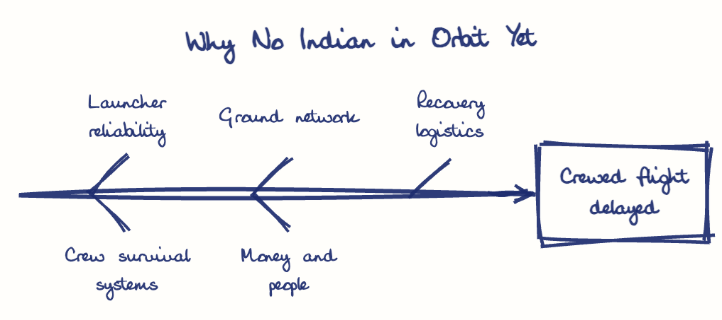
Why No Indian in Orbit Yet effect: Crewed flight delayed → Launcher reliability → Crew survival systems → Ground network → Money and people → Recovery logistics
1. Human-Rated Launcher: The GSLV Mk III had made one orbital flight (June 2017), while human rating needs far higher reliability and redundancy. 2. Crew Survival Systems: There was no flight-proven life support, space suit or tested crew escape system, though the 2014 CARE flight had validated the capsule's heat shield and parachutes. 3. Tracking: Continuous voice and data contact with a crew needs a wide ground network or data-relay satellites, which ISRO lacked.
Funding
Gaganyaan was later sanctioned at about Rs 10,000 crore (2018), many times Mangalyaan's roughly Rs 450 crore.
People and Recovery
India had no astronaut corps, so its Air Force pilots trained in Russia in 2020-21, and sea recovery needs Navy ships and medical teams on standby.
Phased Progress
Crew-escape abort tests in 2018 and 2023, SpaDeX docking in 2025 and Shubhanshu Shukla's 2025 ISS stay show the gaps closing one by one.
Opportunity Cost
Critics say robotic missions give more science per rupee, but crewed flight builds life-support, materials and medical capabilities and prestige that robots cannot.
This model answer is indicative and the model can make mistakes; please verify key facts independently.
Practise this question
1Get the answer sheet
Sized for this question.
2Write your answer
Timed, by hand.
3Get it marked
Your score and what to fix.
This chapter in the exam
Space8 questions
Asked in 8 of 14 sittings since 2013
- 2026Mention salient features of 'Mission Drishti'. Discuss the imaging techniques used in the satellite launched on 3rd May 2026. Why it is being considered world's first satellite of its kind? (Answer in 250 words)
- 2024What are asteroids? How real is the threat of them causing extinction of life? What strategies have been developed to prevent such a catastrophe?
All 8 questions, sorted by sub-topic, with model answers and practice.
Question from the official UPSC Civil Services (Main) Examination 2017 paper. Answer written by Ghissu's engine and checked against our editorial standards. Found an error? Tell us and we correct it within 48 hours.