2017 · GS Paper 4 · Q1 · 10 marks
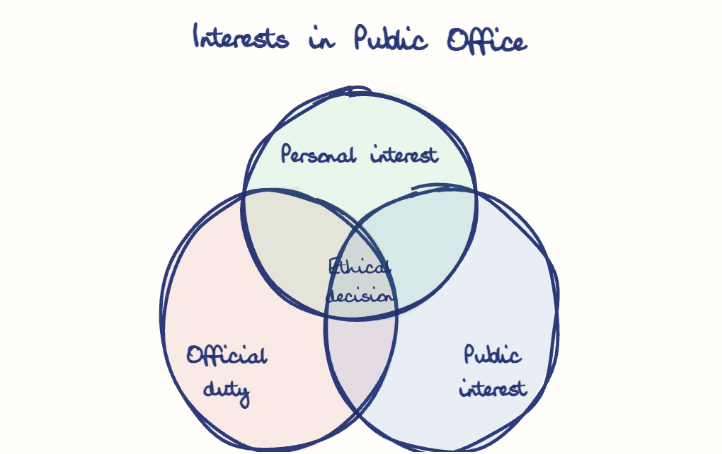
Conflict of interest in the public sector arises when (a) official duties, (b) public interest, and (c) personal interest are taking priority one above the other. How can this conflict in administration be resolved ? Describe with an example.
In short
Conflict in administration arises when personal interest, official duty or public interest takes undue priority, and it is resolved by ranking public interest first, disclosing and recusing, and applying rules by their purpose. Ashok Khemka's 2012 cancellation of a Gurugram land mutation shows public interest prevailing over pressure.
Model answer
Ghissu Editorial · Verified 4 Oct 2026 · 278 words
Personal over official
An officer scoring a tender in which a relative's firm bids lets kinship override impartial duty, which Rule 4(3) of the CCS (Conduct) Rules, 1964 forbids.
Personal over public
An official who buys land along a highway alignment he knows in advance profits from inside information.
Official over public
In Simdega, Jharkhand, 11-year-old Santoshi Kumari died in 2017 after her family's ration card was cancelled for not being linked to Aadhaar, showing rigid rules defeating their purpose.
Order of priority
Public interest first, official duty as its instrument, personal interest last, as the Nolan principle of Selflessness requires.
Disclose and recuse
A personal stake is declared in writing and the file moves to another officer.
Spirit over letter
Where a rule produces a cruel result, the officer applies its purpose, records reasons and seeks a relaxation.
Example
In 2012, Haryana IAS officer Ashok Khemka cancelled the mutation of a Gurugram land deal involving Robert Vadra and DLF despite pressure, placing public interest above career comfort.
This model answer is indicative and the model can make mistakes; please verify key facts independently.
Practise this question
1Get the answer sheet
Sized for this question.
2Write your answer
Timed, by hand.
3Get it marked
Your score and what to fix.
This chapter in the exam
Ethical concerns and dilemmas in government and private institutions13 questions
Asked in 7 of 14 sittings since 2013
- 2026Owing to paucity of time, a university professor generates a Ph.D. evaluation report using Artificial Intelligence and submits it with some modifications. Discuss this from the perspective of accountability and integrity.
- 2026A business house is working on a project that could displace a forest community from their habitat. As the administrative officer of that district, what ethical challenges are you likely to face?
All 13 questions, sorted by sub-topic, with model answers and practice.
Question from the official UPSC Civil Services (Main) Examination 2017 paper. Answer written by Ghissu's engine and checked against our editorial standards. Found an error? Tell us and we correct it within 48 hours.