2017 · GS Paper 4 · Q7(b) · 10 marks
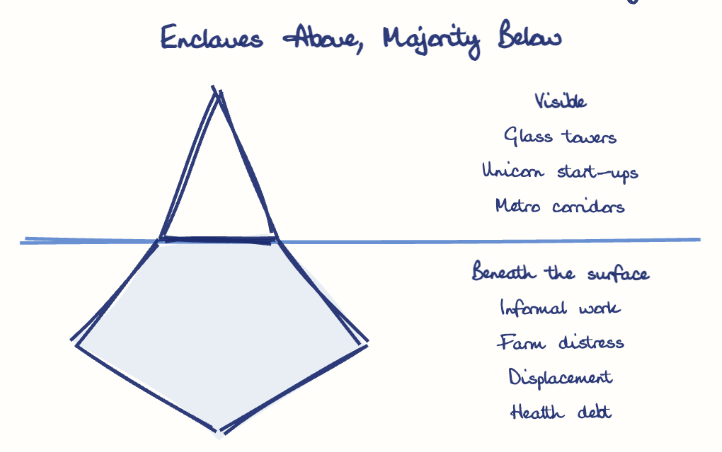
Increased national wealth did not result in equitable distribution of its benefits. It has created only some "enclaves of modernity and prosperity for a small minority at the cost of the majority." Justify.
In short
The statement is largely justified: growth since 1991 multiplied national wealth but concentrated its gains in a few people and places while the majority bore displacement and precarious work. The World Inequality Lab estimates the top 1% held 22.6% of income and about 40% of wealth in 2022-23.
Model answer
Ghissu Editorial · Verified 4 Oct 2026 · 273 words
Concentrated wealth
The World Inequality Lab (2024) estimates that the top 1% held 22.6% of national income and about 40% of wealth in 2022-23, higher than under the British Raj.
Growth without good jobs
Agriculture employs about 46% of workers (PLFS 2023-24) but yields under a fifth of value added.
Spatial islands
Gurugram's gated townships and Mumbai's towers beside Dharavi wall prosperity off from the cities around them.
Displacement
Mines and dams uproot tribal families; in *Orissa Mining Corporation v. MoEF* (2013) Niyamgiri's Dongria Kondh gram sabhas rejected bauxite mining.
Precarious labour
Over 30 crore unorganised workers are on e-Shram, and the 2020 lockdown exodus showed migrants had no safety net.
Failing Rawls's test
The difference principle accepts inequality only if it lifts the least advantaged, which trickle-down growth has not done.
Constitutional promise
Article 39(c) bars concentration of wealth to the common detriment, and Ambedkar warned in 1949 of "a life of contradictions".
This model answer is indicative and the model can make mistakes; please verify key facts independently.
Practise this question
1Get the answer sheet
Sized for this question.
2Write your answer
Timed, by hand.
3Get it marked
Your score and what to fix.
This chapter in the exam
Empathy, tolerance and compassion towards the weaker sections3 questions
Asked in 3 of 14 sittings since 2013
- 2022Apart from intellectual competency and moral qualities, empathy and compassion are some of the other vital attributes that facilitate the civil servants to be more competent in tackling the crucial issues or taking critical decisions. Explain with suitable illustrations.
- 2014We are witnessing increasing instances of sexual violence against women in the country. Despite existing legal provisions against it, the number of such incidences is on the rise. Suggest some innovative measures to tackle this menace.
Question from the official UPSC Civil Services (Main) Examination 2017 paper. Answer written by Ghissu's engine and checked against our editorial standards. Found an error? Tell us and we correct it within 48 hours.