2017 · GS Paper 4 · Q6(b) · 10 marks
Strength, peace and security are considered to be the pillars of international relations. Elucidate.
In short
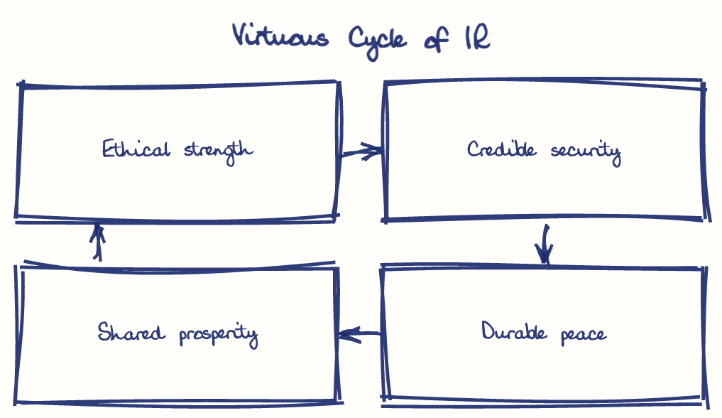
Strength gives a nation the capacity to act, security protects it from traditional and non-traditional threats, and peace is the stable order both should serve, so the three pillars hold only together and under ethics. India's credible minimum deterrence with a No First Use doctrine shows strength used to deter rather than dominate.
Model answer
Ghissu Editorial · Verified 4 Oct 2026 · 270 words
Strength as the base
Military, economic and moral strength give a nation a voice, and India's credible minimum deterrence after Pokhran-II (1998), with a No First Use doctrine (2003), uses strength to deter, not dominate.
Security as the shield
Security now spans cyberspace, energy and health, so Vaccine Maitri (2021) and Operation Dost after the 2023 Turkey-Syria earthquake treated human security as national security.
Peace as the goal
Peace is a stable order of trust, expressed in the Panchsheel principles of 1954 and India's large troop contribution to UN peacekeeping.
Strength without restraint
Russia's invasion of Ukraine in 2022 caused an energy and food crisis far beyond Europe, showing how unchecked power breeds insecurity for all.
Peace without strength
The 1962 war taught India that goodwill must be backed by preparedness.
Security through cooperation
Terrorism and climate change need collective security, which Kant's Perpetual Peace (1795) and the UN Charter seek to provide.
This model answer is indicative and the model can make mistakes; please verify key facts independently.
Practise this question
1Get the answer sheet
Sized for this question.
2Write your answer
Timed, by hand.
3Get it marked
Your score and what to fix.
This chapter in the exam
Ethical issues in international relations and funding9 questions
Asked in 9 of 14 sittings since 2013
- 2026In international relations, ethical considerations are often subjugated to the strategic interests of nation-states. Discuss this from an ethical perspective.
- 2025Carl von Clausewitz once said, "War is a diplomacy by other means." Critically analyse the above statement in the present context of contemporary geo-political conflict.
All 9 questions, sorted by sub-topic, with model answers and practice.
Question from the official UPSC Civil Services (Main) Examination 2017 paper. Answer written by Ghissu's engine and checked against our editorial standards. Found an error? Tell us and we correct it within 48 hours.