2017 · GS Paper 4 · Q9 · 20 marks
You are an honest and responsible civil servant. You often observe the following: (a) There is a general perception that adhering to ethical conduct one may face difficulties to oneself and cause problems for the family, whereas unfair practices may help to reach the career goals. (b) When the number of people adopting unfair means is large, a small minority having a penchant towards ethical means makes no difference. (c) Sticking to ethical means is detrimental to the larger developmental goals. (d) While one may not involve oneself in large unethical practices, but giving and accepting small gifts makes the system more efficient. Examine the above statements with their merits and demerits.
In short
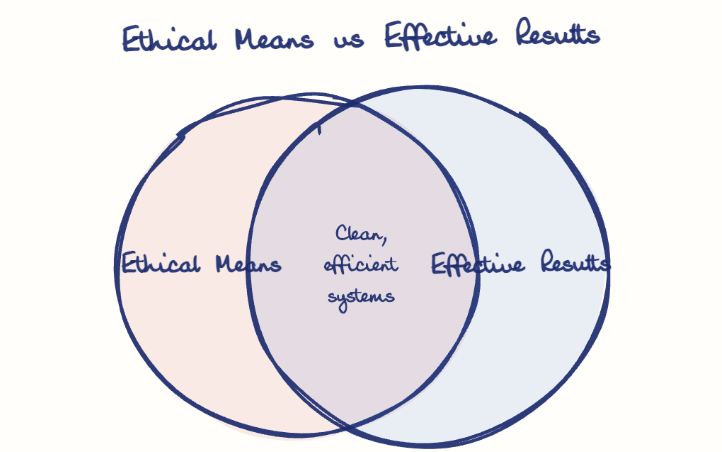
Each statement holds a grain of truth about the cost of ethical conduct but fails as a guide to action, because unethical means undermine the very results they promise. The MKSS movement that produced the RTI Act, 2005 shows a small ethical minority can change the system.
Model answer
Ghissu Editorial · Verified 4 Oct 2026 · 270 words
(a) Personal cost
The risk is real, as Manjunath Shanmugam's murder in 2005 for sealing an adulterating pump showed, but unfair careers often end in disgrace, like the Joshi IAS couple's dismissal in 2014. Taking the shortcut is Moral Myopia.
(b) Power of numbers
Diffusion of Responsibility isolates the lone honest officer, yet a few villagers with the Mazdoor Kisan Shakti Sangathan began the public hearings that produced the RTI Act, 2005, and one honest decision becomes a precedent for others.
(c) Ethics versus growth
Fear of probes did slow decisions in 2011-13, hence Section 17A (2018), but the Commonwealth Games scandal shows corruption inflates costs, while the cleanest Nordic states are also prosperous.
(d) Small gifts
Customary gifts from friends are allowed within the Conduct Rules' limits, but gifts from those with official dealings create a reciprocity debt and a Conflict of Interest, the honey on the tongue that Kautilya warned of.
This model answer is indicative and the model can make mistakes; please verify key facts independently.
Practise this question
1Get the answer sheet
Sized for this question.
2Write your answer
Timed, by hand.
3Get it marked
Your score and what to fix.
This chapter in the exam
Civil Service Ethics: The Discussion Tradition5 questions
Asked in 3 of 14 sittings since 2013
- 2019Honesty and truthfulness are the hallmarks of a civil servant. Civil servants possessing these qualities are considered as the backbone of any strong organisation. While discharging their duties, they take various decisions. Some of these decisions turn out to be bonafide mistakes. Unless such decisions are wilfully taken and provide any personal gain, the officer cannot be held guilty. However, at times, such decisions may have unforeseen adverse consequences in the long run. Recently, there have been instances where civil servants have been prosecuted for bonafide mistakes. They have often been prosecuted and even imprisoned. The ethical fabric of civil servants has been adversely affected on account of these instances. How is this trend impacting the performance of public services? What measures can be taken to ensure that honest civil servants are not prosecuted for bonafide mistakes? Justify your answer.
- 2019In a modern democratic polity, there is the concept of political executive and permanent executive. Elected people's representatives form the political executive and bureaucracy forms the permanent executive. Ministers frame policy decisions and bureaucrats execute these. In the initial decades after independence, relationship between the permanent executive and the political executive were characterized by mutual understanding, respect and co-operation, without encroaching upon each others domain. However, in the subsequent decades, the situation has changed. There are instances of the political executive insisting upon the permanent executive to follow its agenda. Respect for and appreciation of upright bureaucrats has declined. There is an increasing tendency among the political executive to get involved in routine administrative matters such as transfers, postings etc. Under this scenario, there is a definitive trend towards 'politicization of bureaucracy'. The rising materialism and acquisitiveness in social life has also adversely impacted upon the ethical values of both the permanent executive and the political executive. What are the consequences of this 'politicization of bureaucracy'? Discuss.
All 5 questions, sorted by sub-topic, with model answers and practice.
Question from the official UPSC Civil Services (Main) Examination 2017 paper. Answer written by Ghissu's engine and checked against our editorial standards. Found an error? Tell us and we correct it within 48 hours.