2018 · GS Paper 1 · Q6 · 10 marks
Define mantle plume and explain its role in plate tectonics.
In short
A mantle plume is a hot, buoyant column rising from the deep mantle that forms hotspots, records plate motion, splits continents and builds flood basalts. The Reunion plume formed the Deccan Traps about 66 million years ago and is argued to have sped India's northward drift.
Model answer
Ghissu Editorial · Verified 4 Oct 2026 · 266 words
Deep source
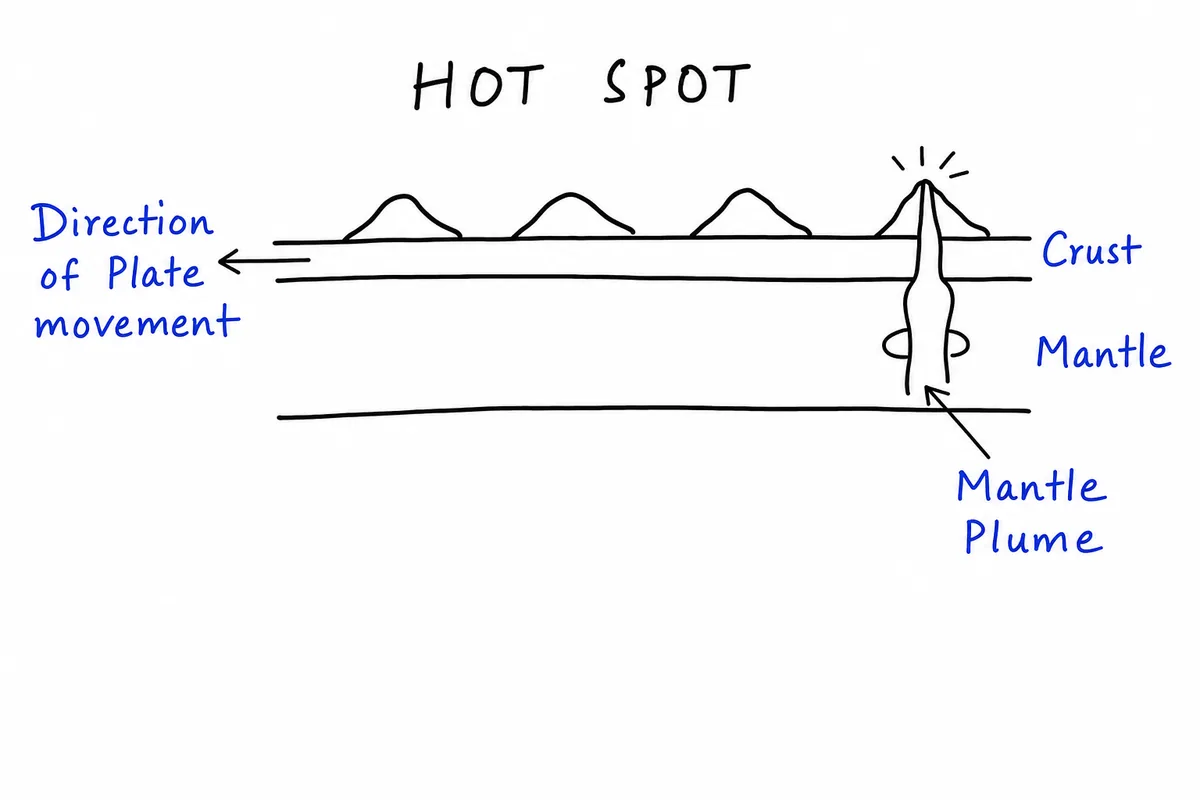
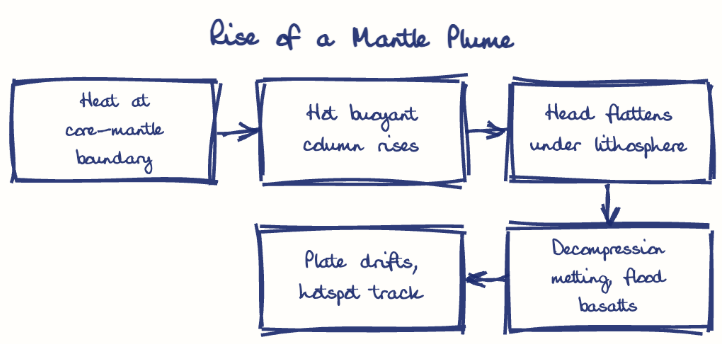
Seismic tomography, such as French and Romanowicz's 2015 imaging, shows broad plume conduits rooted near the core-mantle boundary.
Head and tail
The head melts by decompression under the lithosphere, while the tail feeds a stationary hotspot for millions of years.
Flood basalts
Plume heads produce large igneous provinces, such as the Deccan Traps from the Reunion plume about 66 million years ago.
Recorder of plate motion
A plate sliding over a fixed plume leaves an age-progressive chain, as in the Hawaiian-Emperor chain, whose bend records a change in Pacific plate motion.
Initiator of rifting
Plume heads crack continents, as the Afar plume opened the Red Sea, Gulf of Aden and East African Rift.
Driver of plate speed
Cande and Stegman (2011) argued the Reunion plume pushed India to its fastest northward drift, leaving the Lakshadweep-Chagos ridge as its track.
Explains the exceptions
Plumes explain volcanism far from boundaries, as at Hawaii and Yellowstone.
This model answer is indicative and the model can make mistakes; please verify key facts independently.
Practise this question
1Get the answer sheet
Sized for this question.
2Write your answer
Timed, by hand.
3Get it marked
Your score and what to fix.
This chapter in the exam
The Earth7 questions
Asked in 6 of 14 sittings since 2013
- 2025Discuss how the changes in shape and sizes of continents and ocean basins of the planet take place due to tectonic movements of the crustal masses.
- 2022Discuss the natural resource potentials of Deccan Trap.
All 7 questions, sorted by sub-topic, with model answers and practice.
Question from the official UPSC Civil Services (Main) Examination 2018 paper. Answer written by Ghissu's engine and checked against our editorial standards. Found an error? Tell us and we correct it within 48 hours.