2018 · GS Paper 2 · Q12 · 15 marks
How far do you agree with the view that tribunals curtail the jurisdiction of ordinary courts? In view of the above, discuss the constitutional validity and competency of the tribunals in India.
In short
Tribunals curtailed ordinary courts by design until 1997, but they now act as courts of first instance under High Court review, and their validity rests on judicial independence. L. Chandra Kumar (1997) made High Court review under Articles 226 and 227 part of the basic structure.
Model answer
Ghissu Editorial · Verified 4 Oct 2026 · 324 words
Exclusion by design
Articles 323A(2)(d) and 323B(3)(d) let Parliament oust High Courts, as Section 28 of the Administrative Tribunals Act 1985 did, and the NGT Act 2010 still sends appeals straight to the Supreme Court.
Review restored
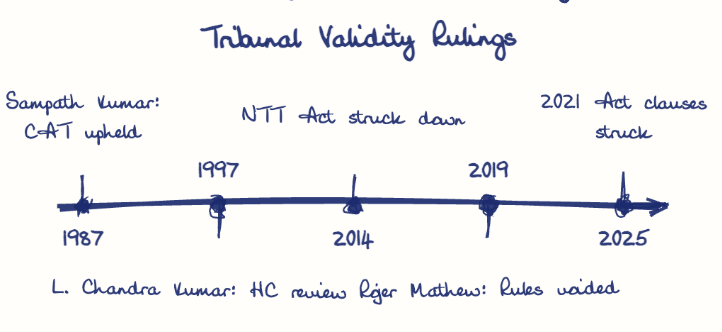
L. Chandra Kumar (1997) made High Court review under Articles 226 and 227 basic structure, so tribunals now supplement courts as courts of first instance.
Valid but subordinate
Sampath Kumar (1987) upheld the 1985 Act, and L. Chandra Kumar let tribunals test any statute except their parent Act.
Core work protected
Madras Bar Association (2014) struck down the National Tax Tribunal because substantial questions of law belong to High Courts.
Independence tested
Rojer Mathew (2019) voided the 2017 Rules, and in 2025 the Court struck provisions of the Tribunals Reforms Act 2021 for re-enacting invalidated tenure clauses.
Competency mixed
The NGT's expertise, seen in its Yamuna floodplain order on the 2016 Art of Living festival, is blunted by vacancies and ministry control.
Independent oversight
A National Tribunals Commission, secure tenure and appeals to High Court division benches would answer criticism of the Tribunal Reforms Bill 2026 (The Hindu, 2026).
This model answer is indicative and the model can make mistakes; please verify key facts independently.
Practise this question
1Get the answer sheet
Sized for this question.
2Write your answer
Timed, by hand.
3Get it marked
Your score and what to fix.
This chapter in the exam
Structure, Organization and Functioning of the States Judiciary4 questions
Asked in 4 of 14 sittings since 2013
- 2025Comment on the need of administrative tribunals as compared to the court system. Assess the impact of the recent tribunal reforms through rationalization of tribunals made in 2021.
- 2024Explain and distinguish between Lok Adalats and Arbitration Tribunals. Whether they entertain civil as well as criminal cases?
All 4 questions, sorted by sub-topic, with model answers and practice.
Question from the official UPSC Civil Services (Main) Examination 2018 paper. Answer written by Ghissu's engine and checked against our editorial standards. Found an error? Tell us and we correct it within 48 hours.