2025 · GS Paper 2 · Q2 · 10 marks
Comment on the need of administrative tribunals as compared to the court system. Assess the impact of the recent tribunal reforms through rationalization of tribunals made in 2021.
In short
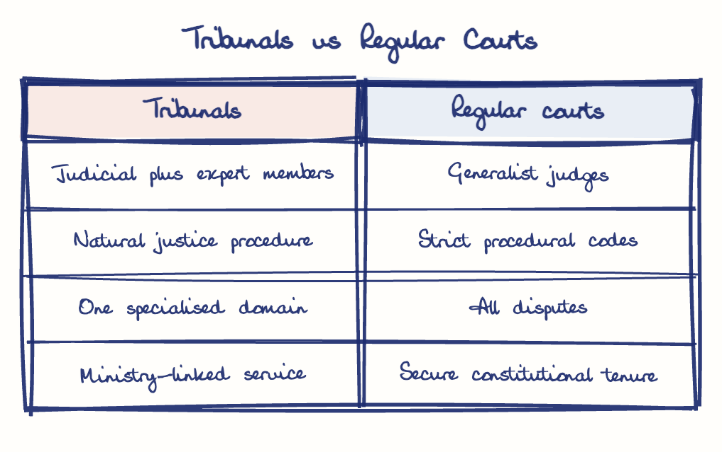
Tribunals are needed beside courts for specialised, faster and cheaper justice, but the 2021 rationalisation trimmed their number more than it secured their independence. It abolished nine appellate bodies, and its tenure provisions were struck down by the Supreme Court in November 2025.
Model answer
Ghissu Editorial · Verified 4 Oct 2026 · 298 words
Domain expertise
Technical members bring specialist knowledge, as in the NCLT for insolvency and the National Green Tribunal for environmental disputes.
Speed and low cost
Bound only by natural justice, tribunals spare litigants, such as government employees in service disputes before the CAT, the Code of Civil Procedure's rigid, costly steps.
Independence caveat
L. Chandra Kumar (1997) held that tribunals supplement, not supplant, High Courts, a safeguard that matters because members depend on parent ministries for appointment and funds.
Leaner structure
Nine appellate bodies, including the Intellectual Property Appellate Board and the Film Certification Appellate Tribunal, were abolished.
Specialised new homes
The Delhi High Court's Intellectual Property Division (2021) and Madras High Court's (2023) kept specialist handling.
Burden shifted
Other appeals moved to High Courts already carrying heavy backlogs, trading specialist speed for general delay.
Independence contested
The Act re-enacted the four-year tenure and minimum age of 50 struck down in Madras Bar Association (2021); in November 2025 the Supreme Court struck them down again and directed a National Tribunals Commission.
This model answer is indicative and the model can make mistakes; please verify key facts independently.
Practise this question
1Get the answer sheet
Sized for this question.
2Write your answer
Timed, by hand.
3Get it marked
Your score and what to fix.
This chapter in the exam
Structure, Organization and Functioning of the States Judiciary4 questions
Asked in 4 of 14 sittings since 2013
- 2024Explain and distinguish between Lok Adalats and Arbitration Tribunals. Whether they entertain civil as well as criminal cases?
- 2019The Central Administration Tribunal which was established for redressal of grievances and complaints by or against central government employees, nowadays is exercising its powers as an independent judicial authority. Explain.
All 4 questions, sorted by sub-topic, with model answers and practice.
Question from the official UPSC Civil Services (Main) Examination 2025 paper. Answer written by Ghissu's engine and checked against our editorial standards. Found an error? Tell us and we correct it within 48 hours.