2018 · GS Paper 2 · Q19 · 15 marks
What are the key areas of reform if the WTO has to survive in the present context of Trade War, especially keeping in mind the interest of India?
In short
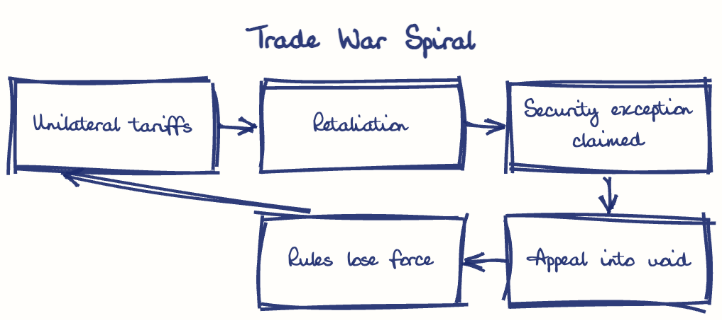
The WTO must revive its Appellate Body, narrow the security exception and guard consensus, while securing India's food security and special and differential treatment. Its Appellate Body has been dysfunctional since December 2019, leaving rulings open to appeal into the void.
Model answer
Ghissu Editorial · Verified 4 Oct 2026 · 266 words
Revive the Appellate Body
Dysfunctional since December 2019, it needs restoring, since the interim MPIA has only 57 members (RIS, 2026).
Tame the security exception
Building on the 2019 Russia: Traffic in Transit ruling, Article XXI needs an agreed test so it cannot cloak protectionism.
Guard consensus
Plurilaterals on e-commerce and investment, which advance without India, must enter the rulebook only by consensus under Article X.9.
Food security
A permanent public stockholding solution must replace the Bali peace clause, and 1986-88 reference prices must go, as developed members hold 95 percent of AMS entitlements (RIS, 2025).
Special and differential treatment
With 122 of 166 members developing (RIS, 2026), India must resist ending self-declared status.
Fisheries and green rules
Fisheries subsidy curbs must spare small fishers, and the EU's CBAM needs WTO discipline.
Coalitions and hedges
Lead the G33 on food security, back a reformed Appellate Body, and use the India-UK CETA and India-EFTA TEPA as complements, not substitutes.
This model answer is indicative and the model can make mistakes; please verify key facts independently.
Practise this question
1Get the answer sheet
Sized for this question.
2Write your answer
Timed, by hand.
3Get it marked
Your score and what to fix.
This chapter in the exam
Institutions12 questions
Asked in 10 of 14 sittings since 2013
- 2025"The reform process in the United Nations remains unresolved, because of the delicate imbalance of East and West and entanglement of the USA vs. Russo-Chinese alliance." Examine and critically evaluate the East-West policy confrontations in this regard.
- 2024Terrorism has become a significant threat to global peace and security.' Evaluate the effectiveness of the United Nations Security Council's Counter Terrorism Committee (CTC) and its associated bodies in addressing and mitigating this threat at the international level.
All 12 questions, sorted by sub-topic, with model answers and practice.
Question from the official UPSC Civil Services (Main) Examination 2018 paper. Answer written by Ghissu's engine and checked against our editorial standards. Found an error? Tell us and we correct it within 48 hours.