2018 · GS Paper 2 · Q4 · 10 marks
Why do you think the committees are considered to be useful for parliamentary work? Discuss, in this context, the role of the Estimates Committee.
In short
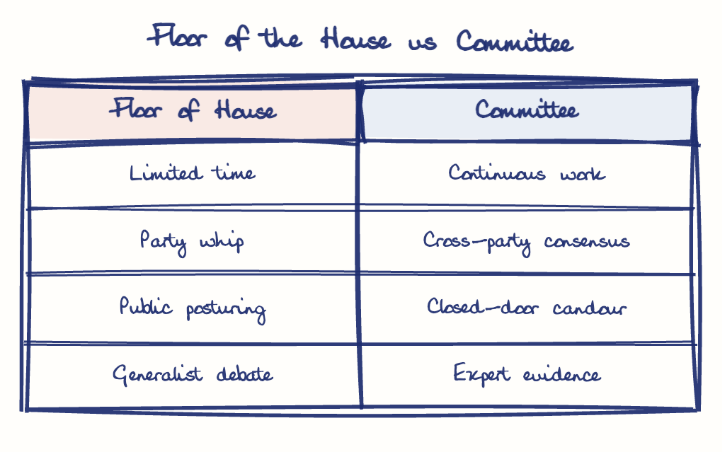
Committees are useful because they give Parliament time, expertise, evidence and cross-party consensus that the floor cannot. The Estimates Committee, formed in 1950 with 30 Lok Sabha members, acts as a continuous economy committee, though it acts after the vote and only advises.
Model answer
Ghissu Editorial · Verified 4 Oct 2026 · 281 words
Division of labour
Committees scrutinise bills, grants and policies in parallel while the House legislates, so a short session still yields detailed scrutiny.
Expertise and evidence
Members build expertise and hear officials and experts, as the Joint Committee on the Insolvency and Bankruptcy Code did before the law passed in 2016.
Consensus beyond the whip
Closed-door sittings without cameras let members reason across party lines and often report unanimously.
Continuous economy
Formed in 1950, its 30 Lok Sabha members suggest economies and improvements in organisation and efficiency.
Alternative means
It may propose alternative policies for efficiency and tests whether money is well laid out within policy.
Form of the budget
It suggests how estimates should be presented to Parliament, improving how the House reads the budget.
The limits
It examines estimates after they are voted, cannot question policy approved by Parliament, covers only a few ministries a year, and only advises.
This model answer is indicative and the model can make mistakes; please verify key facts independently.
Practise this question
1Get the answer sheet
Sized for this question.
2Write your answer
Timed, by hand.
3Get it marked
Your score and what to fix.
This chapter in the exam
Parliament — Conduct of Business5 questions
Asked in 4 of 14 sittings since 2013
- 2023Explain the structure of the Parliamentary Committee system. How far have the financial committees helped in the institutionalisation of Indian Parliament?
- 2021Do Department-related Parliamentary Standing Committees keep the administration on its toes and inspire reverence for parliamentary control? Evaluate the working of such committees with suitable examples.
All 5 questions, sorted by sub-topic, with model answers and practice.
Question from the official UPSC Civil Services (Main) Examination 2018 paper. Answer written by Ghissu's engine and checked against our editorial standards. Found an error? Tell us and we correct it within 48 hours.