2018 · GS Paper 3 · Q1 · 10 marks
"Access to affordable, reliable, sustainable and modern energy is the sine qua non to achieve Sustainable Development Goals (SDGs)." Comment on the progress made in India in this regard.
In short
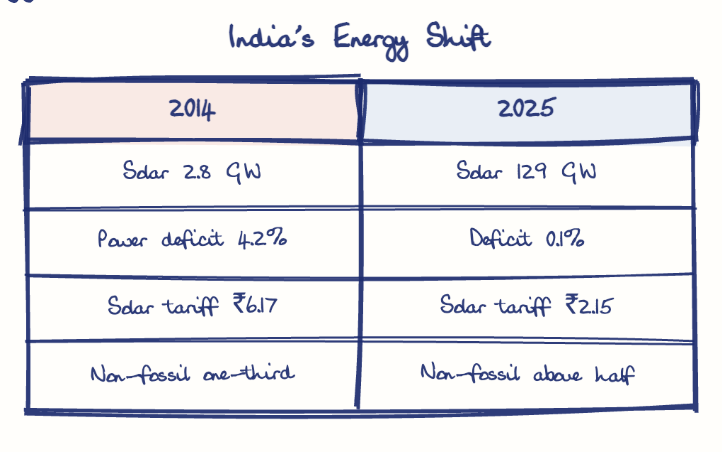
India has nearly met SDG 7's access goal through village electrification, Saubhagya and Ujjwala, and non-fossil sources now exceed half of installed capacity. Coal still generates about three-fourths of electricity, and storage and cooking-fuel use lag behind.
Model answer
Ghissu Editorial · Verified 4 Oct 2026 · 289 words
Universal access
DDUGJY electrified every inhabited village by April 2018, and Saubhagya connected about 2.86 crore households.
Clean cooking
Pradhan Mantri Ujjwala Yojana (2016) has given over 10 crore LPG connections to poor women, cutting indoor smoke.
Efficiency
UJALA distributed over 36 crore LED bulbs, lowering household bills and peak demand.
Clean supply
Non-fossil sources crossed half of India's roughly 500 GW capacity in 2025 (PIB), years ahead of the 2030 NDC target, and PM Surya Ghar reached nearly 24 lakh rooftops.
Reliability
Rural feeders still face cuts, and DISCOM losses, though narrowing after a ₹2,701 crore profit in FY25 (PIB), keep supply fragile.
Access without use
Many Ujjwala families refill cylinders only a few times a year and return to firewood when prices rise.
Coal and storage
Coal still generates about three-fourths of electricity, and only about 5.5 GW of storage backs 243 GW of renewables (Standing Committee on Energy, 2025).
This model answer is indicative and the model can make mistakes; please verify key facts independently.
Practise this question
1Get the answer sheet
Sized for this question.
2Write your answer
Timed, by hand.
3Get it marked
Your score and what to fix.
This chapter in the exam
Developments, Applications and Effects in Everyday Life23 questions
Asked in 13 of 14 sittings since 2013
- 2026Distinguish between a Fast Breeder Reactor (FBR) and a thermal nuclear reactor. In the context of first indigenously developed prototype FBR at Kalpakkam, explain the term 'criticality'. What are its implications for clean energy future of our country? (Answer in 150 words)
- 2025How can India achieve energy independence through clean technology by 2047 ? How can biotechnology play a crucial role in this endeavour ?
All 23 questions, sorted by sub-topic, with model answers and practice.
Question from the official UPSC Civil Services (Main) Examination 2018 paper. Answer written by Ghissu's engine and checked against our editorial standards. Found an error? Tell us and we correct it within 48 hours.