2018 · GS Paper 3 · Q5 · 10 marks
Discuss the work of 'Bose-Einstein Statistics' done by Prof. Satyendra Nath Bose and show how it revolutionized the field of Physics.
In short
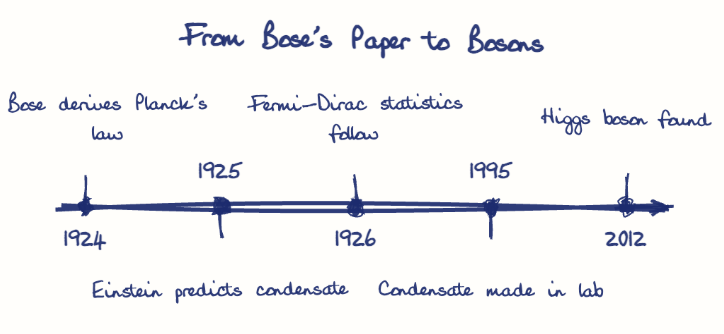
S.N. Bose derived Planck's radiation law in 1924 by counting identical light quanta statistically, and Einstein extended it to atoms, founding Bose-Einstein statistics. This gave physics bosons, the Bose-Einstein condensate created in 1995, and the basis for lasers and the Higgs boson.
Model answer
Ghissu Editorial · Verified 4 Oct 2026 · 283 words
The problem
Planck's black-body law (1900) relied on classical electromagnetism, which clashed with Einstein's light quanta.
Bose's method
He treated radiation as a gas of photons and counted their arrangements in phase-space cells of size h cubed, deriving Planck's law from statistics alone.
Indistinguishability
He treated photons as truly identical, so swapping two gives no new state, breaking with classical Maxwell-Boltzmann counting.
Einstein's extension
In 1924-25 Einstein applied it to gas atoms and predicted the Bose-Einstein condensate near absolute zero.
Bosons
Dirac named such particles "bosons"; all force carriers, from photons to gluons, obey this statistics, while matter particles follow the complementary Fermi-Dirac statistics.
New state of matter
Cornell, Wieman and Ketterle created the condensate in 1995 and won the 2001 Nobel Prize, opening work on quantum sensors.
Phenomena explained
It explains helium-4 superfluidity and the coherent light of lasers, which underpin today's optical and photonic technologies.
Higgs boson
CERN's 2012 discovery completing the Standard Model carries Bose's name.
This model answer is indicative and the model can make mistakes; please verify key facts independently.
Practise this question
1Get the answer sheet
Sized for this question.
2Write your answer
Timed, by hand.
3Get it marked
Your score and what to fix.
This chapter in the exam
Achievements of Indians in Science & Technology2 questions
Asked in 2 of 14 sittings since 2013
Question from the official UPSC Civil Services (Main) Examination 2018 paper. Answer written by Ghissu's engine and checked against our editorial standards. Found an error? Tell us and we correct it within 48 hours.