2019 · GS Paper 3 · Q5 · 10 marks
How was India benefitted from the contributions of Sir M. Visvesvaraya and Dr. M. S. Swaminathan in the fields of water engineering and agricultural science respectively?
In short
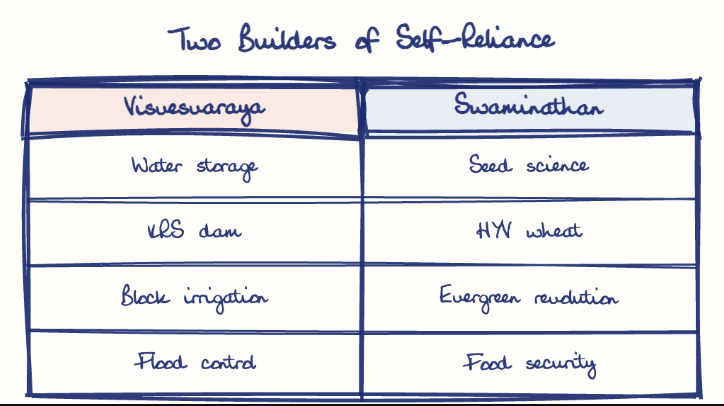
Sir M. Visvesvaraya gave India modern water storage, irrigation and flood control, while Dr. M.S. Swaminathan led the Green Revolution and the idea of an evergreen revolution. Visvesvaraya's KRS dam on the Kaveri (1932) and Swaminathan's semi-dwarf wheat from 1963 moved India from scarcity to food self-reliance.
Model answer
Ghissu Editorial · Verified 4 Oct 2026 · 280 words
Automatic sluice gates
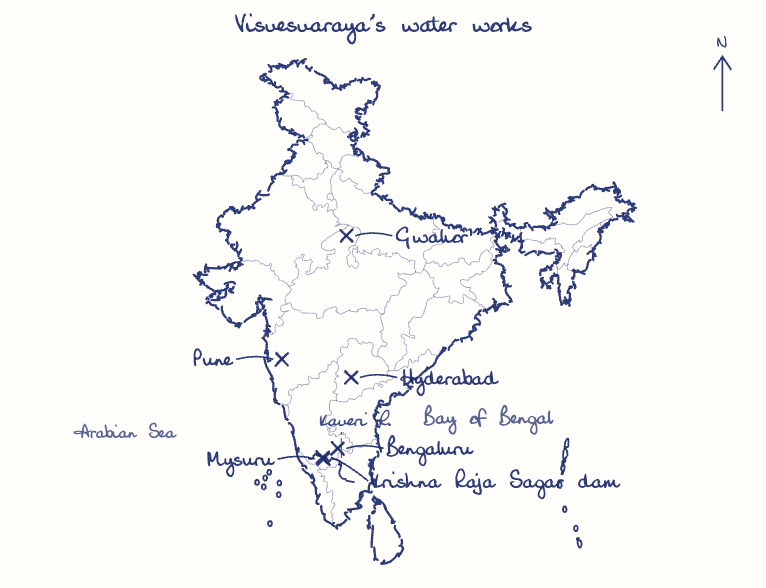
His automatic flood gates, first fitted at Khadakwasla near Pune in 1903, raised storage and released floodwater safely.
Block system
Rotating canal water among blocks of land in the Deccan shared scarce water fairly and checked waterlogging.
KRS dam
As Diwan of Mysore (1912-18) he drove the Krishna Raja Sagara dam on the Kaveri (1932), irrigating Mandya and supplying Bengaluru and Mysuru.
Flood control
After the 1908 Musi floods he planned Osman Sagar and Himayat Sagar, protecting Hyderabad.
Green Revolution
With Norman Borlaug he adapted Mexican semi-dwarf wheat from 1963, ending "ship to mouth" dependence on PL-480 imports.
Institutions
As ICAR Director General (1972-79) he built the research and extension chain; he won the first World Food Prize in 1987.
Evergreen revolution
He warned against soil and water exhaustion and sought productivity without ecological harm, carried forward by his foundation's biovillages.
Farmer welfare
His National Commission on Farmers (2004-06) recommended MSP at C2 plus 50 per cent.
This model answer is indicative and the model can make mistakes; please verify key facts independently.
Practise this question
1Get the answer sheet
Sized for this question.
2Write your answer
Timed, by hand.
3Get it marked
Your score and what to fix.
This chapter in the exam
Achievements of Indians in Science & Technology2 questions
Asked in 2 of 14 sittings since 2013
Question from the official UPSC Civil Services (Main) Examination 2019 paper. Answer written by Ghissu's engine and checked against our editorial standards. Found an error? Tell us and we correct it within 48 hours.