2018 · GS Paper 4 · Q5(b) · 10 marks
Explain the process of resolving ethical dilemmas in Public Administration.
In short
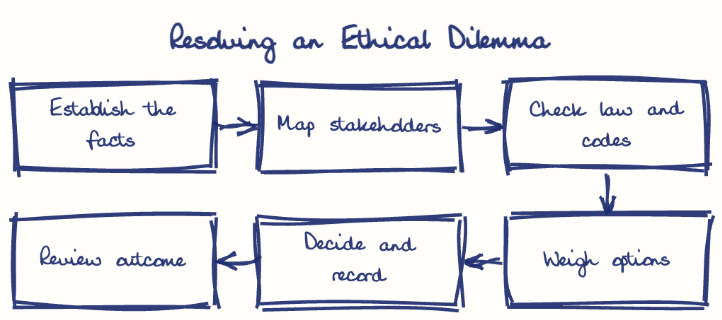
Ethical dilemmas in public administration are resolved through a disciplined process: establish facts, map stakeholders, check law and codes, test options morally, decide and record reasons, then review. The Supreme Court's 1990 ruling in S.N. Mukherjee v Union of India requires authorities exercising quasi-judicial functions to record reasons.
Model answer
Ghissu Editorial · Verified 4 Oct 2026 · 279 words
Development vs welfare
A collector clearing encroachments for a drainage project weighs the rule of law against the shelter of poor families.
Loyalty vs public interest
Satyendra Dubey of the NHAI wrote to the Prime Minister's Office in 2002 about corruption in the Golden Quadrilateral project and was murdered in 2003.
Personal vs official
A relative's firm bidding for a contract one must sanction sets family ties against impartial duty.
Hierarchy of guidance
The officer climbs from conscience to rules, statutes and the Constitution; the higher source prevails and conscience guides only where they are silent.
Moral tests
Options are tested against Kant's categorical imperative, the utilitarian greatest good, and Gandhi's talisman of the poorest person.
Consultation
Seniors, legal advisers and affected people are heard, and emotional intelligence keeps fear or anger from hijacking judgement.
Reasons on record
In S.N. Mukherjee v Union of India (1990), the Supreme Court held that authorities exercising quasi-judicial functions must record reasons, making the choice transparent and reviewable.
This model answer is indicative and the model can make mistakes; please verify key facts independently.
Practise this question
1Get the answer sheet
Sized for this question.
2Write your answer
Timed, by hand.
3Get it marked
Your score and what to fix.
This chapter in the exam
Ethical concerns and dilemmas in government and private institutions13 questions
Asked in 7 of 14 sittings since 2013
- 2026Owing to paucity of time, a university professor generates a Ph.D. evaluation report using Artificial Intelligence and submits it with some modifications. Discuss this from the perspective of accountability and integrity.
- 2026A business house is working on a project that could displace a forest community from their habitat. As the administrative officer of that district, what ethical challenges are you likely to face?
All 13 questions, sorted by sub-topic, with model answers and practice.
Question from the official UPSC Civil Services (Main) Examination 2018 paper. Answer written by Ghissu's engine and checked against our editorial standards. Found an error? Tell us and we correct it within 48 hours.