2018 · GS Paper 4 · Q5(a) · 10 marks
Suppose the Government of India is thinking of constructing a dam in a mountain valley bound by forests and inhabited by ethnic communities. What rational policy should it resort to in dealing with unforeseen contingencies?
In short
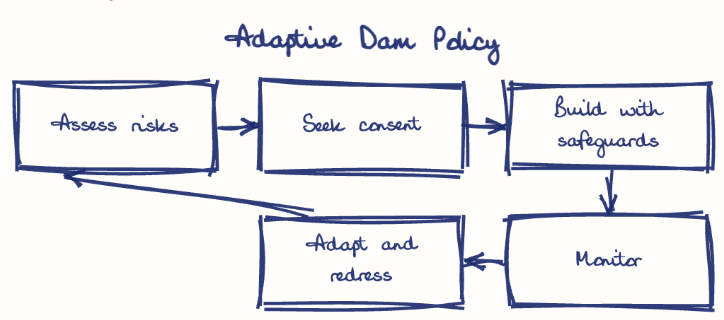
A rational policy for a dam in a forested, tribal mountain valley is adaptive: precautionary risk assessment, gram sabha consent, rehabilitation before submergence, emergency plans and benefit sharing. The 2021 Chamoli flood that wrecked the Rishiganga project shows why surprises must be planned for.
Model answer
Ghissu Editorial · Verified 4 Oct 2026 · 272 words
Precautionary Assessment
Cumulative studies of seismicity, landslides and glacial lakes must precede clearance; the 2023 South Lhonak outburst breached Sikkim's Chungthang dam downstream.
Informed Consent
Gram sabha consent under the Forest Rights Act, 2006 and PESA, upheld in Niyamgiri (2013), treats communities and their sacred groves as stakeholders, not compensation items.
Rehabilitation First
The RFCTLARR Act, 2013 mandates social impact assessment, and the Narmada Bachao Andolan judgment (2000) tied rehabilitation pari passu to dam height.
Emergency Preparedness
The Dam Safety Act, 2021 requires emergency action plans and periodic safety reviews, which should include early-warning sirens reaching downstream villages.
Adaptive Monitoring
An independent panel including community members should review flows, slopes and forest loss, with power to redesign or halt work.
Benefit Sharing
The Hydro Power Policy, 2008 earmarks 1% additional free power for a Local Area Development Fund, and a time-bound grievance cell gives displaced families quick redress.
This model answer is indicative and the model can make mistakes; please verify key facts independently.
Practise this question
1Get the answer sheet
Sized for this question.
2Write your answer
Timed, by hand.
3Get it marked
Your score and what to fix.
This chapter in the exam
Ethical concerns and dilemmas in government and private institutions13 questions
Asked in 7 of 14 sittings since 2013
- 2026Owing to paucity of time, a university professor generates a Ph.D. evaluation report using Artificial Intelligence and submits it with some modifications. Discuss this from the perspective of accountability and integrity.
- 2026A business house is working on a project that could displace a forest community from their habitat. As the administrative officer of that district, what ethical challenges are you likely to face?
All 13 questions, sorted by sub-topic, with model answers and practice.
Question from the official UPSC Civil Services (Main) Examination 2018 paper. Answer written by Ghissu's engine and checked against our editorial standards. Found an error? Tell us and we correct it within 48 hours.