2018 · GS Paper 4 · Q6(b) · 10 marks
what do each of the following quotations mean to you in the present context? "Anger and intolerance are the enemies of correct understanding." — Mahatma Gandhi
In short
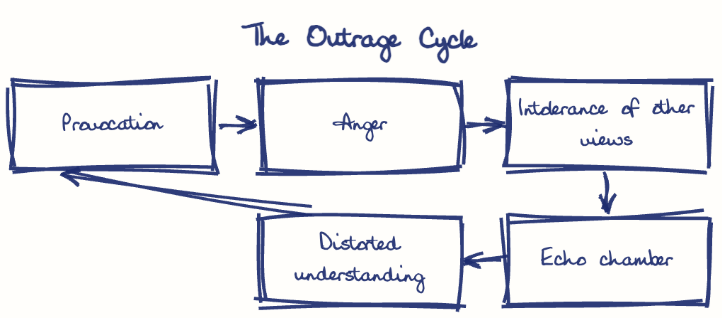
Gandhi warns that anger overrides reason and intolerance shuts out other views, so both block the understanding on which fair judgment depends. Mob lynchings fed by WhatsApp rumours, which prompted the Supreme Court's 2018 guidelines in Tehseen Poonawalla, show the cost today.
Model answer
Ghissu Editorial · Verified 4 Oct 2026 · 278 words
Anger Clouds Reason
Anger produces an Emotional Hijack; the Gita (2.63) traces the chain from anger to delusion to the ruin of judgment.
Intolerance Closes the Mind
Refusing to hear the other side leaves judgment to Confirmation Bias, while Jain Anekantavada teaches that truth has many sides.
Understanding before Action
Both vices block the step on which every fair decision depends, so a calm, open mind is a condition of justice.
Not a Call to Passivity
Gandhi turned righteous indignation into disciplined, non-violent action rather than indifference.
Digital Public Sphere
WhatsApp rumours fed mob lynchings, prompting the Supreme Court's guidelines in Tehseen Poonawalla v Union of India (2018).
Public Administration
An officer who meets an angry crowd with Social Awareness hears the real grievance, while anger escalates conflict and produces wrong orders.
Democratic Deliberation
Ambedkar warned in 1949 against the "grammar of anarchy", yet disruptions of Parliament show anger replacing debate.
Between Nations
India's message at Samarkand in 2022 that "today's era is not an era of war" places dialogue above anger.
This model answer is indicative and the model can make mistakes; please verify key facts independently.
Practise this question
1Get the answer sheet
Sized for this question.
2Write your answer
Timed, by hand.
3Get it marked
Your score and what to fix.
This chapter in the exam
Contributions of moral thinkers and philosophers from India23 questions
Asked in 13 of 14 sittings since 2013
- 2026In what ways can an Indian Administrative Officer apply Gandhi's notion of 'trusteeship' to ensure fairness in governance?
- 2025What do each of these quotations convey to you in the present context? "Those who in trouble untroubled are, Will trouble trouble itself." – Thiruvalluvar
All 23 questions, sorted by sub-topic, with model answers and practice.
Question from the official UPSC Civil Services (Main) Examination 2018 paper. Answer written by Ghissu's engine and checked against our editorial standards. Found an error? Tell us and we correct it within 48 hours.