2018 · GS Paper 4 · Q4(b) · 10 marks
With regard to morality of actions, one view is that means are of paramount importance and the other view is that the ends justify the means. Which view do you think is more appropriate? Justify your answer.
In short
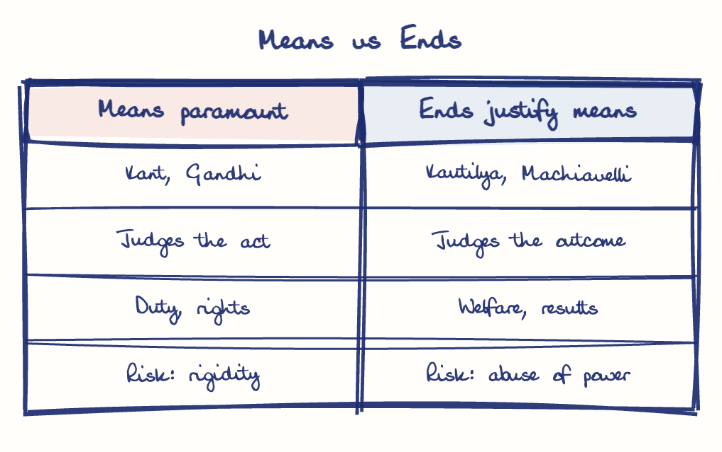
The view that means are paramount is more appropriate, provided good ends still guide action within lawful, rights-respecting limits. Kant's Categorical Imperative and Gandhi's seed-and-tree analogy show why, while the Emergency (1975-77) shows the cost of letting ends justify any means.
Model answer
Ghissu Editorial · Verified 4 Oct 2026 · 285 words
Dignity as a limit
Kant's Categorical Imperative forbids treating a person merely as a means, so custodial torture stays wrong even if it yields a confession.
Means shape ends
Gandhi likened means to the seed and ends to the tree (Hind Swaraj, 1909), and withdrew Non-Cooperation after Chauri Chaura (1922).
Rule of law
PUCL v State of Maharashtra (2014) laid down encounter-killing guidelines because a state that breaks the law to fight crime loses its legitimacy.
Outcomes matter
The Utilitarian Calculus justifies disaster triage or the 2020 lockdown, which restricted liberty to save lives.
Statecraft and realism
Kautilya's sama, dana, danda and bheda, and Machiavelli's prince, show that rigid purity of means can paralyse a state facing real threats.
The danger of inversion
Ends-Means Inversion marked the Emergency (1975-77), when "discipline" justified censorship and forced sterilisations; ends are uncertain, but the harm of wrong means is certain.
This model answer is indicative and the model can make mistakes; please verify key facts independently.
Practise this question
1Get the answer sheet
Sized for this question.
2Write your answer
Timed, by hand.
3Get it marked
Your score and what to fix.
This chapter in the exam
Dimensions of ethics13 questions
Asked in 8 of 14 sittings since 2013
- 2026Citing the serious adverse effects of long-term medication, a doctor convinces the family of a female patient for surgery. This led the patient to reluctantly consent for the surgery, though her original choice was to opt for medication. Explain the concepts of paternalism and beneficence by analysing the doctor's action.
- 2026Some moral philosophers argue that spending some of your resources—without significantly affecting your financial stability—to help other people who badly suffer is our moral duty and not merely a matter of charity. Justify this claim by explaining the distinction between duty and charity.
All 13 questions, sorted by sub-topic, with model answers and practice.
Question from the official UPSC Civil Services (Main) Examination 2018 paper. Answer written by Ghissu's engine and checked against our editorial standards. Found an error? Tell us and we correct it within 48 hours.