2026 · GS Paper 4 · Q4(a) · 10 marks
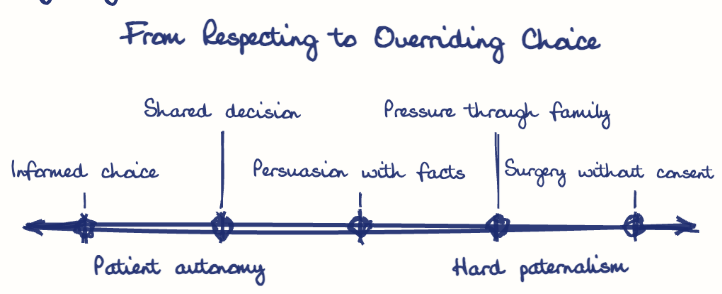
Citing the serious adverse effects of long-term medication, a doctor convinces the family of a female patient for surgery. This led the patient to reluctantly consent for the surgery, though her original choice was to opt for medication. Explain the concepts of paternalism and beneficence by analysing the doctor's action.
In short
The doctor acted from beneficence, the duty to protect the patient's welfare, but used paternalistic means by persuading her family and overriding her own preference for medication. Samira Kohli v Prabha Manchanda (2008) requires the patient's own real, informed consent, which a reluctant yes through relatives does not give.
Model answer
Ghissu Editorial · Verified 4 Oct 2026 · 278 words
Beneficence
The duty to act for the patient's welfare and prevent harm, one of Beauchamp and Childress's four principles of medical ethics with autonomy, non-maleficence and justice.
Paternalism
Overriding or bypassing a competent adult's choice for her supposed good; Joel Feinberg's soft form intervenes only when a choice is uninformed, the hard form even when it is informed.
Beneficent intent
Warning of the serious adverse effects of long-term medication was a genuine act of care.
Paternalistic means
Convincing the family rather than the patient turned persuasion into pressure and reflected a gendered habit of deciding for women; since her preference was already informed, this slides towards hard paternalism.
Consent in name only
Samira Kohli v Prabha Manchanda (2008) held that consent must be the patient's own, real and informed; a reluctant yes through relatives fails that test.
Autonomy as a right
Common Cause (2018) and Puttaswamy (2017) place the right to refuse treatment and bodily autonomy within Article 21.
This model answer is indicative and the model can make mistakes; please verify key facts independently.
Practise this question
1Get the answer sheet
Sized for this question.
2Write your answer
Timed, by hand.
3Get it marked
Your score and what to fix.
This chapter in the exam
Dimensions of ethics13 questions
Asked in 8 of 14 sittings since 2013
- 2026Some moral philosophers argue that spending some of your resources—without significantly affecting your financial stability—to help other people who badly suffer is our moral duty and not merely a matter of charity. Justify this claim by explaining the distinction between duty and charity.
- 2024The application of Artificial Intelligence as a dependable source of input for administrative rational decision-making is a debatable issue. Critically examine the statement from the ethical point of view.
All 13 questions, sorted by sub-topic, with model answers and practice.
Question from the official UPSC Civil Services (Main) Examination 2026 paper. Answer written by Ghissu's engine and checked against our editorial standards. Found an error? Tell us and we correct it within 48 hours.