2019 · GS Paper 1 · Q6 · 10 marks
Can the strategy of regional resource-based manufacturing help in promoting employment in India?
In short
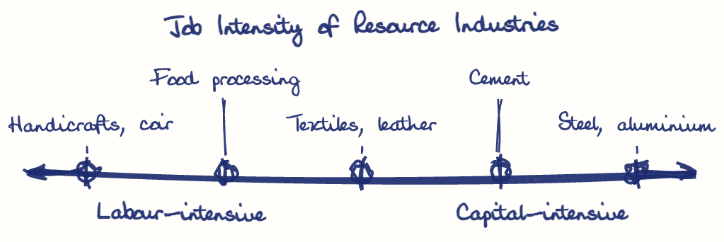
Regional resource-based manufacturing can largely promote employment when built on labour-intensive agro, forest and craft clusters, but only partly when it relies on capital-intensive mining and metals. Kerala's coir and cashew units and UP's One District One Product scheme show the job potential.
Model answer
Ghissu Editorial · Verified 4 Oct 2026 · 276 words
Local value addition
Kerala's coir units built on local coconut husk and Assam's tea factories beside the gardens employ large numbers of workers near home.
Farm and forest linkages
Food processing absorbs surplus farm labour, and TRIFED's Van Dhan Vikas Kendras (2018) help tribal gatherers process forest produce.
Cluster policy
UP's One District One Product scheme (2018) and the 2017 Indian Forest Act amendment freeing bamboo grown outside forests from felling and transit permits widened local manufacturing.
Capital-intensive minerals
Odisha and Jharkhand host big steel and aluminium plants, yet many mining districts remain poor, a resource curse.
Displacement
The abandoned POSCO project in Odisha (2017) and the closure of Sterlite's Thoothukudi smelter (2018) show the cost of conflict.
Weak infrastructure and skills
Poor power, credit and training mean raw material still leaves unprocessed.
Market limits
Small units struggle with quality, branding and finance, and stay exposed to global commodity price swings.
This model answer is indicative and the model can make mistakes; please verify key facts independently.
Practise this question
1Get the answer sheet
Sized for this question.
2Write your answer
Timed, by hand.
3Get it marked
Your score and what to fix.
This chapter in the exam
International Trade / Transport and Activities12 questions
Asked in 9 of 14 sittings since 2013
- 2026"The centre of global trade is gradually shifting from the Atlantic region to the Indo-Pacific region." Examine this statement.
- 2022Mention the significance of straits and isthmus in international trade.
All 12 questions, sorted by sub-topic, with model answers and practice.
Question from the official UPSC Civil Services (Main) Examination 2019 paper. Answer written by Ghissu's engine and checked against our editorial standards. Found an error? Tell us and we correct it within 48 hours.