2019 · GS Paper 2 · Q6 · 10 marks
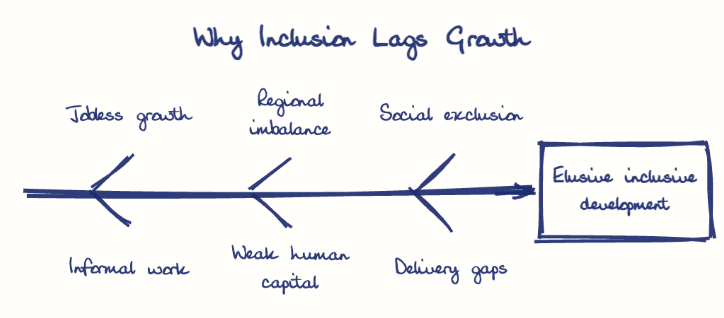
Despite Consistent experience of high growth, India still goes with the lowest indicators of human development. Examine the issues that make balanced and inclusive development elusive.
In short
India's growth has not become inclusive because it creates few jobs, keeps most workers informal, concentrates gains in some regions and groups, and under-invests in health, education and women's work. The UNDP Human Development Report 2025 still ranks India 130th of 193 countries.
Model answer
Ghissu Editorial · Verified 4 Oct 2026 · 304 words
Growth without jobs
Services-led growth creates few jobs, while PLFS 2023-24 shows about 46% of workers still in agriculture, which yields under a fifth of output.
Informal work
Around nine in ten workers lack contracts or social security; over 30 crore have registered on e-Shram.
Regional imbalance
NITI Aayog's National MPI 2023 found about a third of Bihar's people poor in 2019-21 against under 1% in Kerala.
Concentrated gains
The World Inequality Lab estimates the top 1% took about 22.6% of national income in 2022-23.
Under-invested human capital
Government health spending is about 1.5% of GDP and education below NEP 2020's 6% goal; NFHS-5 found 35.5% of under-five children stunted.
Gender exclusion
Female labour force participation reached 41.7% in 2023-24 (PLFS), much of it unpaid, and India ranked 131st of 148 in the Global Gender Gap Report 2025.
Caste and community deficits
The Sachar Committee (2006) found Muslims deprived in almost every dimension, and SC and ST households lag in assets and higher education.
Weak delivery
Vacant frontline posts, leakages and weak panchayats blunt schemes, which is why JAM-based direct transfers matter.
This model answer is indicative and the model can make mistakes; please verify key facts independently.
Practise this question
1Get the answer sheet
Sized for this question.
2Write your answer
Timed, by hand.
3Get it marked
Your score and what to fix.
This chapter in the exam
Human Resources4 questions
Asked in 4 of 14 sittings since 2013
- 2023The crucial aspect of development process has been the inadequate attention paid to Human Resource Development in India. Suggest measures that can address this inadequacy.
- 2016"Demographic Dividend in India will remain only theoretical unless our manpower becomes more educated, aware, skilled and creative." What measures have been taken by the government to enhance the capacity of our population to be more productive and employable ?
All 4 questions, sorted by sub-topic, with model answers and practice.
Question from the official UPSC Civil Services (Main) Examination 2019 paper. Answer written by Ghissu's engine and checked against our editorial standards. Found an error? Tell us and we correct it within 48 hours.